A man enters a beautiful London apartment and calmly shoots it’s resident, crime boss Lenny Taylor, in the leg.
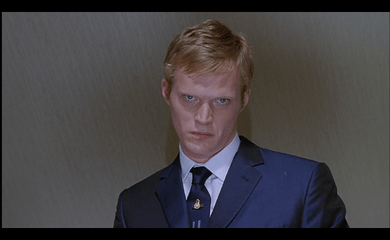
Not in panic. Not in a hot burst of rage. He does it with the clipped, practical air of a man getting started. Then he crosses the room, turns up the radiogram to drown out the noise, and Why by Anthony Newley blooms into the house with all the charm of a high school last dance, and the smoothness of an older Britain still convinced charm can keep the darkness in its place. Only after that does he begin to prepare himself. He takes his time. Removes his cufflinks. Gently rolls up his silk tie. Immaculately folds up his suit trousers. Hangs his suit jacket perfectly on the chair so he doesn’t crease the sleeves. The movements are measured, almost household in their calm. The atmosphere is less like a murder about to happen than a man settling into a routine before work, or putting the kettle on while the day gathers itself. That is what makes the scene in Gangster No. 1 so unnerving. The killing has not properly begun, yet the room already feels morally dead.
The terror lies in the mundanity of his composure. Most screen violence arrives as rupture. Somebody snaps. A threshold is crossed. However savage the act, the audience is still allowed to recognise it as a break in ordinary conduct. This scene denies that comfort. Bettany’s gangster does not appear to cross into violence. He appears to continue into it. The radiogram, the tidying instinct, the unhurried preparation, all of it gives the sense that brutality belongs to the same inner system as grooming, dressing, and maintaining order. The murder feels less like an eruption than a task he has made room for. And how many murders like it has he committed to get to being so calm at this point?
That is why Anthony Newley is so poisonous here. His voice carries old cultural furniture with it. Theatrical polish. Variety stage brightness. A neatly pressed public self. It evokes a world of supper clubs, patter, stage lights, and smiling self possession. In another setting that sound would signal wit, seduction, or harmless performance. In this scene it survives intact while everything human around it sours. That survival is what gives the moment its hauntological charge. An older language of charm remains perfectly audible inside a room where charm has become obscene. The past has not vanished. It has been left running whilst the world around it rots.
That is what hauntology means at its most vivid. Not simply old things, but old promises continuing after the life has gone out of them. A song made for pleasure still speaks in the same tone after pleasure has become cruelty. A voice made for entertainment keeps smiling while the soul in the room turns abyssal. The effect is far darker than ordinary irony because the music does not comment from a distance. It reveals that the forms of civility can outlive the values that once made them civilised. What remains is style without conscience, order without goodness, grace without mercy.
That is why the scene feels spiritually foul rather than merely violent. Newley’s brightness does not soften the horror. It civilises the air around it. The gangster seems perfectly at ease inside that air. He does not need to psyche himself up. He does not look torn, ashamed, or exhilarated. He looks organised. That is the revolting part. The scene suggests a man whose inner life has absorbed cruelty so fully that he can approach it with steadiness. Violence has become compatible with poise. That leaves the viewer with the ugliest possible thought, that this is not some singular descent but a familiar mental pathway. A person only moves with that much ease when the act has already become natural to him, whether through previous deeds or through obsessive rehearsal of them.
The scene’s tension depends on that exact calm. Every second of preparation tightens the wire. Once the radiogram is playing and he begins moving through the room with such composure, the audience understands that the murder cannot be quick or ordinary. It must be utterly horrific. The sequence creates a debt. It promises that whatever follows must justify this level of ritual control. If the payoff were blunt and simple, the scene would collapse into empty style. Instead it delivers something much worse than spectacle. When the film shifts into Lennie’s grainy 16mm point of view, the murder becomes more disturbing precisely because it refuses the clean, exterior view of violence. You are denied the safe distance of looking at a body from the outside. You are pushed inside panic, impact and helplessness. The coarse image feels degraded, almost contaminated, as though the film itself has been dragged down into something private and vile. That choice is far more upsetting than a straightforward display of blood would have been.
Gore can become decorative very quickly. Once violence is arranged for the viewer, there is always the risk of technique taking over. You notice the effect, the makeup, the staging. The 16mm texture in this scene strips away that comfort. It does not present the murder as an object to inspect. It traps you in its confusion. The horror becomes experiential rather than visual. That is why the absence of explicit injury makes it worse. The imagination is forced to complete what the film withholds, and the result feels less like watching a death than being dragged through one. The murder loses any trace of cinematic glamour and becomes raw ordeal.
This shift matters for the hauntological reading as well. Up to that point, the scene is built from surface. The radiogram. The old song. The rituals of self presentation. The carefully managed atmosphere. Then the viewpoint drops through that polished crust into something degraded and immediate. It is like the scene tearing open its own wallpaper. The old world of manners and smooth sound is still present, but now it is exposed as nothing more than a veneer laid over something feral. The music goes on speaking in the language of control while the image reveals what that control has been serving all along.
That is also why the connection with A Clockwork Orange feels earned rather than decorative. The comparison matters because both films understand that cheerful music can make violence feel normal to the perpetrator. Alex singing “Singin’ in the Rain” through violation is horrifying because he sounds completely at home inside it. Bettany’s gangster reaches a similarly disgusting register, though in a colder key. Alex performs cruelty with exuberance. The gangster in Gangster No. 1 approaches it with ritual composure. One dances through evil. The other prepares for it with the calm of habit. Both scenes imply repetition, a history beneath the act, a private world in which brutality has already been absorbed into style. Roger Ebert explicitly noted how strongly Gangster No. 1 invites comparison to A Clockwork Orange, from Malcolm McDowell’s presence to Bettany’s Alex like menace.
There is something distinctly British in the sickness of this scene. Not patriotic, not quaint, but culturally recognisable in its fixation on surface control. Stiff upper lip and stoicism in the face of the horrific. It is the smiling before going over the top of the trenches. The room stays orderly. The music stays elegant. The man stays composed. What has vanished is the moral content that ought to sit beneath those forms. That is why Newley feels so exact. His voice embodies a kind of social smoothness, and the film turns that smoothness into camouflage. The old signs of polish remain, but they no longer point to decency. They point to a person who has learned how to keep the room neat while making himself monstrous.
That is what makes the sequence so much more than a nasty murder scene. It is a vision of civility after the soul has leaked out. Hauntology often finds its power in the persistence of cultural leftovers, old voices, old songs, old moods, all still audible after the futures and values that produced them have failed. This scene condenses that feeling into one room. The radiogram hums with an older confidence. The man listening to it has become pure appetite shaped into ritual. The past survives as tone. Humanity does not.
By the time Lennie dies, the scene has already told you what is truly wrong. The worst part is not simply that the gangster is capable of such brutality. The worst part is how ordinary it seems to him. He enters, injures, adjusts the music, and prepares himself with the quiet steadiness of a man easing into a familiar duty. Anthony Newley keeps smiling through it all.
And that smile is what haunts the scene.
 Hauntology.co.uk
Leave a comment