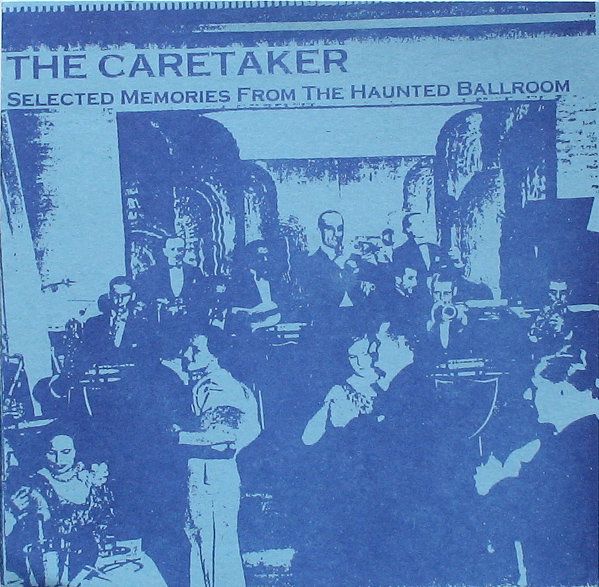
Before the reaction videos to his 6 hour opus and the TikTok snippets, in the ancient era that is 1999, The Caretaker opened his front door to us all for the first time.
He did not fling it wide in some grand theatrical gesture. He did not arrive with a statement of intent, a lecture on memory, or a neat little placard explaining what listeners were about to experience. He simply let us into the room. Selected Memories From the Haunted Ballroom remains the proper beginning because it reaches the source before the noise around it began. Before the project became shorthand for collapse, before it was folded into internet ritual, before people started approaching it like a dare rather than a piece of art, there was this first glimpse of the house itself. The corridor light low, the music already playing somewhere deeper in, the air holding a politeness that feels both welcoming and faintly wrong.
Beginning here changes the whole shape of The Caretaker. It puts distance between the work and the cheapened idea of it. For many people, the project now exists as a solemn online object, something to be endured, reacted to, clipped up and discussed in the vocabulary of psychic devastation. That misses the first and most important thing about it. The Caretaker was never only interesting because it was bleak. It was moving because it let beauty survive damage. It allowed warmth to remain audible even while the room around it began to loosen.
The old ballroom records at the heart of this first release are not being used as museum pieces. They are not there simply because antique music sounds eerie once it crackles a bit. They once belonged to a world that believed atmosphere could steady people. Rooms could be softened. Loneliness could be dressed well. Desire could be guided into graceful shapes. Sadness could be given a tune and sent gliding around the floor until it looked almost elegant. This music came from a culture that put enormous faith in arrangement. Light the room correctly, polish the brass, let the right melody rise, and perhaps human beings might hold themselves together for an evening.
What Kirby heard inside those records was not only charm, but strain. Not only romance, but effort. These were not neutral artefacts from a vanished social world. They were small engines of emotional management. They smoothed the edges of things. They made longing feel civil. They made private ache look presentable. Once lifted out of their original setting and left to drift through fog, hiss, and distance, they reveal their fragility. The music still smiles, but now the smile trembles. It still offers grace, though the confidence behind that grace has started to thin.
That is where the hauntological charge begins. Not in age alone, certainly not in nostalgia for its own sake, but in the survival of feeling inside a damaged form. A lot of writing on The Caretaker goes straight for ruin. It hears the static and declares a funeral. It hears the distortion and decides the point must be obliteration. Too easy. Too blunt. The real ache comes from the opposite direction. The distortion never fully kills the happiness inside the source material. It discolours it, pulls it out of shape, burdens it with distance, but the light remains audible. That is the miracle and the wound.

One can still hear the old room trying to glow. One can still feel the human impulse that made those melodies in the first place. Bodies turning under chandeliers. Polite conversation bending toward flirtation. Shoes moving over a polished floor. The tiny absurd courage involved in dressing for the evening and pretending, for a few hours, that grace might be enough to hold back loneliness. Kirby does not erase this. He lets it persist under pressure. The crackle and the haze do not simply signify decay. They frame endurance. They let the buried brightness show through all the more painfully because it arrives injured.
That is what makes Selected Memories From the Haunted Ballroom so much more profound than the flattened internet reading of The Caretaker as mere sonic despair. The record is full of pleasure, though pleasure seen through damaged glass. The melodies are still reaching outward. They are still trying to do their old work. What haunts is that they can no longer fully complete it. The room survives as atmosphere, yet the social world that once gave it certainty has receded. What remains is etiquette without secure ground beneath it, elegance after belief, charm with the supporting beams beginning to give way.
The ballroom itself matters enormously. A ballroom is not just a room. It is a social machine. It teaches feeling how to move. It disciplines bodies into grace. It turns longing into choreography. It is civilisation at its most decorative and hopeful, a place where vulnerability is dressed up and sent out among mirrors and brass and orchestras. That is why it becomes so charged once it starts to come apart. A cellar has darkness built into it. A ruin expects melancholy. A ballroom is different. It was built to flatter the human wish that beauty might make life manageable. Once that beauty begins to curdle, the effect is much more disturbing.
This feeling is not confined to old records. It lives in ordinary places too, provided the atmosphere catches correctly. Think of being a kid and hearing piped in music in a shopping centre reverberating all around, not from one visible source, but seeming to rise from the walls themselves. A cheerful tune drifting through escalator hum, fluorescent light, and the shuffle of shoppers carrying carrier bags under artificial skylight. The song tries to soften the space, tries to make circulation feel airy and pleasant, yet the reverb transforms it into something stranger. It no longer belongs to a person. It belongs to the building. The walls seem to remember it. The structure itself starts to feel faintly haunted by the promise that retail comfort was once meant to carry.
Or picture a busker playing saxophone in a crowded street, the notes pushing out through the white noise of engines, chatter, footsteps, plastic bags, fragments of argument, snippets of laughter. For a few seconds the melody cuts through the city’s blur and turns the whole street into a scene. The ordinary flow of bodies becomes charged. The tune makes room for feeling where feeling had no business appearing. Then it is swallowed again by the rush. That is a deeply hauntological sensation. Not because it is sad in any obvious way, but because one hears how fragile beauty is, how briefly it can gather the world into shape before being dispersed back into noise.
The Caretaker works in exactly that territory. He deals in fragile arrangements, in forms that try to keep hold of their purpose while time and damage pull at the edges. The distortion and static are not just signs of erosion. They expose how much emotional life can survive in altered states. Happiness, however fragmented, still shines through tarnish. Comfort remains present even when the logic holding it together begins to disappear. A melody can lose its footing and still carry tenderness. That is the deeper truth sitting inside the music.
Hauntology lives there. Not in dead things sitting inert behind glass, but in traces that continue to glow after the systems around them have failed. The future attached to them may have stalled, soured, or fallen apart altogether, yet the emotional charge remains. One hears it in old signage, in faded public design, in outmoded tones of reassurance, in spaces that still speak in a voice of civic confidence long after the world that produced that confidence has become much less certain. One hears it in music most clearly of all, because music can retain mood even after context has thinned away.
That is where The Caretaker begins to overlap with contemporary culture in a deeper sense than the online discourse ever managed. We now live among resurfaced fragments. Phones throw old photographs back at us with no regard for sequence or emotional consequence. Playlists retrieve songs from long dead versions of ourselves. Digital life has made memory less like a quiet inner chamber and more like interrupted signal. Things return out of order. Feeling arrives without full explanation. Small pieces of the past burst into the present carrying more charge than their size should allow. The Caretaker anticipated this atmosphere, though in a far more elegant and unsettling form than any algorithm could.
A comparison, surprisingly, with BoJack Horseman becomes useful here for the same reason. The show understood that a human being is held together by unstable arrangements. Stories we tell ourselves, emotional patterns, recurring props, rooms that remember us, phrases that linger, scraps of memory that remain vivid while larger structures become uncertain. In its finest moments, memory is shown not as a clean archive, but as a place where some things burn brightly while others lose their shape altogether. Logic breaks first at the edges. Feeling keeps glowing in stray pockets. The self goes lopsided rather than disappearing all at once.
That is close to what Kirby hears in old ballroom music. A social form surviving in partial condition. A bright human signal still flickering inside a damaged container. A melody trying to remember its own posture. The emotional effect comes not from simple loss, but from the contrast between disintegration and persistence. Remove persistence and the whole thing becomes merely gloomy. Remove the damage and it becomes only historical charm. The Caretaker’s genius lies in holding both at once.
This is what so much writing on hauntology misses. There is too much emphasis on gloom, decline, static, institutional eeriness, the old classroom projector, the abandoned shopping precinct, the cracked information board. All useful images in their place, but incomplete if the bright charge inside them is ignored. A haunting requires residue. It requires some sign that the world once tried to offer warmth, order, pleasure, or reassurance. Without that lingering invitation, there is no ache, only emptiness. The reason an old melody heard through dust and interference can be so devastating is that the original feeling still reaches us. Bent out of shape, certainly. Wounded. Distant. But still alive enough to be felt.
One could say that Kirby makes damage audible in such a way that it reveals the thing damage cannot quite extinguish. He does not restore the old world. He does something far better. He lets its emotional afterglow remain visible inside the corrosion. The static becomes the dark cloth against which the small surviving lights show themselves more clearly. Each wobble and veil of noise reminds the listener that the beauty is no longer secure, which only makes that beauty more affecting. It is the sound of grace under pressure.
A pristine transfer of these old recordings would likely be charming, perhaps even moving, but it would not expose their vulnerability in the same way. It would leave them too tidy. Kirby makes them tremble. He allows them to sound as though they are holding on. That subtle shift changes everything. The music ceases to be mere archive and becomes emotional evidence. One hears how much hope had once been placed in atmosphere. One hears how carefully human beings tried to arrange themselves against despair.
This gives Selected Memories From the Haunted Ballroom its peculiar dignity. The record never begs for sympathy. It simply lingers in that unsettling space where warmth and ruin coexist. The room still stands. The band is still technically playing. The dance has not fully stopped. Yet the certainty that once held the evening together has receded into haze. What remains is something both damaged and radiant. Something that refuses to go dark in a clean or complete way.
No wonder it continues to feel so contemporary. Modern life is full of surviving forms. Social scripts continue after conviction has thinned. Institutions keep their polite voice while the ground underneath grows less stable. Buildings continue piping out carefully selected music in the hope that movement can be softened into mood. Streets fill with accidental beauty that briefly interrupts the rush and then vanishes back into traffic. People curate themselves out of fragments and carry old selves around in their pockets without meaning to. Everywhere one looks, emotional traces are surfacing through broken logic.
The Caretaker heard all of this early because he understood something basic and painful about culture. Human beings leave warmth behind them. Not only ruins, not only debris, but warmth. It clings to songs, rooms, surfaces, small habits of arrangement. It remains long after the reasons for it have become obscure. Distortion can wound that warmth, but cannot always erase it. Time can scatter the pieces and the pieces still catch light.
That is what gives the project its depth. Not despair alone, but stubborn radiance. Not the fact that memory decays, but the fact that something tender often survives the decay. Not a dead ballroom, but one where the last glimmers of grace keep appearing through the dust.
The internet, predictably, reduced the work to a shorthand for suffering. In doing so it missed the very quality that makes The Caretaker linger in the bloodstream. Under the hiss, under the blur, under the weight of time, one still hears the old invitation. Come in. Take someone’s hand. Let the room hold you for a while. That invitation is what makes the damage hurt. It is also what makes the music beautiful.
The best hauntological art never gives us ruin by itself. It gives us life still shining from within the ruin, however faintly. Kirby understood that from the beginning. Selected Memories From the Haunted Ballroom remains the clearest proof. Before the project became a legend, before the clips and reactions and solemn online reverence, there was this first opening of the door and the discovery that the room was not empty after all.
The old world was still there in fragments, still offering its wounded glamour, still trying to be kind through the hiss of white noise.
And maybe, just maybe, if you take time to listen through the white noise of everyday life, you might hear the ghosts of those who trod the same ground before you were even born, smile as they dance through the static.
 Hauntology.co.uk
Leave a comment