Aspects of hauntology often arrive at unexpected times and then stay with you for years. Little did I know that a short film bundled free with an Xbox magazine demo disc in 2009, half my lifetime ago now, would be one of those moments.
At the time it did not feel important. It was just there, tucked in among the usual extras, another odd inclusion to click on out of idle curiosity. That is often how these things begin. They slip into your life without ceremony, without any sense that they are about to settle in the mind more deeply than bigger, louder, more self important works ever manage. What’s in the Box? had that quality from the start. It did not overwhelm. It lingered. It left behind a feeling rather than a single shock, and over time that feeling became more interesting than whatever immediate plot or image first carried it in.
What stayed with me was not only the abandoned city, though the city does a great deal of the work. Nor was it simply the trespass sensation, the feeling of moving through somewhere you should not be seeing in this condition, as if you have arrived after the event but before the official story has been finished. The deeper unease came from something colder than simple desolation. The place still felt administered. It still seemed to belong to systems. The barriers, the corners, the routes through the space, the dead civic geometry of it all suggested not collapse but continuation. A city emptied of ordinary life, yet still held inside the logic of management.That is the note the film hits so well. Not disorder. Order without comfort.
A great deal of horror depends on rupture. Something escapes. Something appears. Something breaks through the ordinary surface of life and turns the world upside down. What’s in the Box? works by doing almost the opposite. Its world has already been processed. Whatever catastrophe sits behind the film has not simply wrecked the environment. It has been met, interpreted, and folded into response.
The atmosphere comes not from a failure of system but from the suspicion that the system is still functioning perfectly well under conditions where its original purpose no longer means very much. Not that the world is going to shit. Its that the powers that be had a plan anyway.
That is much worse.
The city in the film does not feel ancient or romantically ruined. It does not have the softness of a place nature has reclaimed and made picturesque. It feels recent. Practical. Measured. It is full of the kinds of spaces that imply oversight. Service roads. Checkpoints. Urban cavities designed for transit and control rather than beauty. The impression is not that people once lived richly here, but that they once moved through it according to instruction. The buildings and streets do not merely frame human presence. They retain the memory of human direction. They suggest that once upon a time someone knew where the lines were, who was allowed through, what counted as secure, and how risk was meant to be handled.That is where the hauntological force begins to gather. Not because the film is old enough now to carry digital dust around it, and not because abandoned urban imagery automatically counts as eerie if you stare at it long enough, but because the world on screen seems haunted by official confidence. It feels like the remains of a future once spoken about in the language of preparedness.
A future of containment plans, designated zones, trained operatives, sealed environments, clean responses. The sort of future that assumes every threat can be classified, every breach can be isolated, every crisis can be broken down into stages and met with the proper tools.
Then the tools become the source of dread.
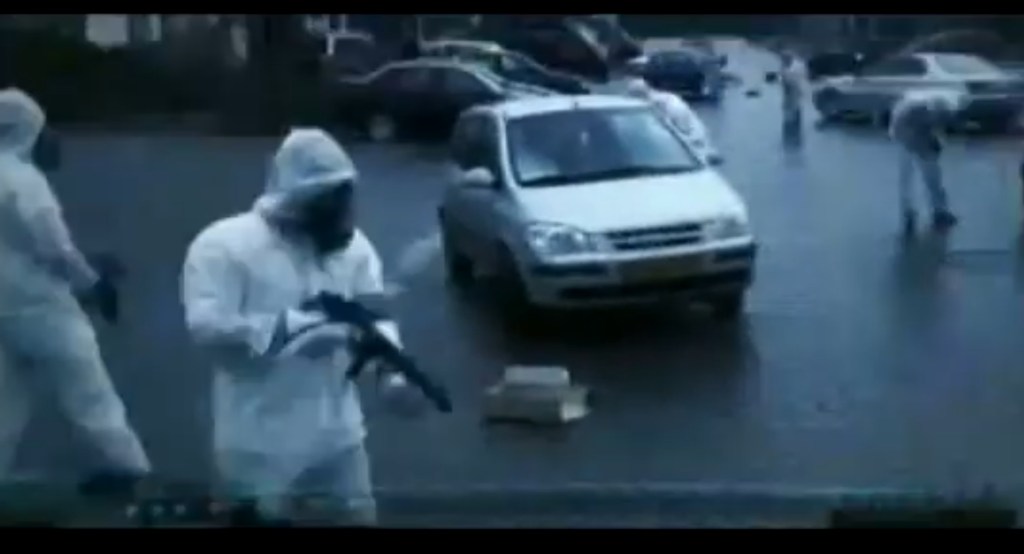
The hazmat suited figures with flamethrowers are what turn the film from merely uncanny into something much colder. Their power does not come from madness. They are too controlled for madness. Too composed. Too much like men carrying out a task whose shape was decided long before they entered the frame. That is exactly why they work. Fire in horror usually reads as emotion. Rage, panic, purification, spectacle. Here it feels procedural. It does not erupt. It is applied. It has the quality of sanctioned action, of a problem being processed through the correct channel. That quality is what gives the image its aftertaste.
Protective equipment normally belongs to a visual language of reassurance. The suit, the gloves, the visor, the sealed surfaces of it all suggest competence standing between the public and invisible danger. They imply years of training, care, method. Probably a canteen somewhere. Reverse that meaning and the effect is immediate. The same clothing that once promised safety now suggests a total removal of ordinary human contact. The body inside the suit is insulated from consequence. Gesture is reduced to function. Compassion disappears behind equipment designed not to feel.
The future does not arrive as a shining machine here.
It arrives as a sealed operator carrying out an ugly necessity with a steady hand. There is something especially disturbing about the calmness of it. A raving villain is easy to place. A creature is easy to fear. A figure performing destruction in the tone of official work is harder to shake. It speaks to a darker possibility, which is that the most frightening thing in a crisis may not be the thing requiring containment, but the mechanism that already knows how to continue once containment becomes indistinguishable from erasure.That is a deeply modern fear. Not the beast in the woods, but the response unit. Not chaos at the gate, but the managed answer to chaos. One sees versions of that fear all through contemporary life. The sense that systems built to stabilise reality can slowly become devoted to their own continuation, until the people inside them matter less than the smooth running of the process. Once that thought enters a horror film, the tone changes completely. The threat no longer feels exceptional. It feels bureaucratically inevitable.
The abandoned city is crucial because civic space is never innocent. Every stairwell, fence, overpass, concrete channel, loading bay and tunnel carries an older confidence inside it. Somebody designed movement here. Somebody anticipated use. Somebody believed the environment could direct bodies into legible patterns and keep the world manageable. Empty countryside may evoke loneliness, but an empty city evokes intention without inhabitants. It retains the shape of purpose after the people who gave purpose meaning have gone.
That is a very different kind of silence. The film leans into this with admirable restraint. It does not need grand explanatory speeches or elaborate lore because the architecture is already doing the work. The city itself suggests a history of regulation. The space has been divided, channelled, and prepared. Even emptied out, it still seems answerable to authority. Then the suited figures enter and complete the picture. They do not disrupt the atmosphere. They confirm it. They make visible what the city has implied from the beginning, which is that order has survived longer than empathy.This is what makes the film feel so closely aligned with hauntology at its strongest.
Hauntology is often misunderstood as a mood of oldness, a fondness for static, concrete, warning symbols and obsolete media formats. That is the shallow reading. The deeper current has always been about broken promises surviving in form. The future as once imagined does not vanish entirely. It leaves behind surfaces, tones, operating assumptions, ways of arranging the world. Those remnants continue speaking in the voice of confidence even after the confidence itself has collapsed. What remains is not just the past. It is the residue of a plan.What’s in the Box? is saturated in that residue.It carries the atmosphere of a world still governed by response, containment and official logic, but emptied of whatever humane purpose once justified those things. The result is more unsettling than simple ruin. Ruin can be passive. This feels active. The city has not died and fallen quiet. It has been abandoned to a process still capable of issuing instructions.
That distinction matters.
A dead structure can be mourned. A dead promise still performing its duties is much harder to face. The flamethrowers sharpen this perfectly. They are not frightening only because they destroy. They are frightening because they transform the clean up operation into the central horror. Fire becomes less an element than an extension of policy. One is no longer watching violence in the ordinary cinematic sense. One is watching procedure become visible. That shift is where the film gets under the skin. It asks a much colder question than most horror bothers with. What if the worst thing in the room is not the contamination, the creature, the unknown object, but the official method for dealing with it?That question has more depth to it than a standard scare because it turns fear outward into structure.
Suddenly the menace is not simply an event. It is a system. Not a singular aberration, but a chain of decisions, protocols and authorised gestures. The horror becomes infrastructural.
There is something particularly memorable about the absence of melodrama. The suited men are not staged like gothic harbingers or slasher villains. They have the blunt, sealed finality of industrial equipment. They are frightening in the way a locked compound is frightening. In the way distant floodlights are frightening. In the way a decontamination arch set up in a place where such a thing should never be needed is frightening. They belong to a world where response has become more chilling than whatever prompted it.Perhaps that is why the film has endured in memory so well. Not every detail remains crystal clear after all these years, but the emotional arrangement does. The dead shell of organised life. The sensation of official logic outliving ordinary human presence. The appearance of men who seem less like antagonists than operatives acting under orders no one is left to question. The sense that protection has curdled into ritual. Those things stay.
Even the title helps. What’s in the Box? has the shape of a harmless question. It sounds like a child’s game, a cheap stage trick, a line belonging to surprise rather than dread. Set against the film’s atmosphere, the phrase takes on a very different weight. Curiosity becomes contaminated. The box stops being a site of wonder and becomes a problem in a chain of custody. A simple question suddenly sounds as though it belongs on a form.That is the film in miniature. Innocent surfaces absorbed into systems of handling and response.
Nothing needs to become grotesque in order to feel poisoned. It only needs to be placed inside the wrong structure.
A lesser executed piece would have pushed harder, explained more, shown too much, or tried to inflate itself into a grand apocalypse. What’s in the Box? is more intelligent than that. It leaves enough unsaid for the atmosphere to keep breathing. It trusts the viewer to feel what is wrong with a city that still looks governable. It trusts the visual language of procedure to do the unsettling work. Above all, it understands that official calm, once detached from care, can be more frightening than any monster.That is why it lasted.
Not as a perfect recollection of scenes, but as a pressure in the imagination. A sense of modernity stripped of its human alibi. A world still dressed in the outer manners of safety, response and control, yet running on toward something far bleaker.
And that, for me, is one of hauntology’s clearest and most unnerving forms. Not a ghost in the old sense, but a dead promise continuing to operate. Not the collapse of official procedure, but its survival under catastrophic conditions. Not chaos in the ruins, but management in the ruins.
The city is empty. The system remains.


Leave a Reply