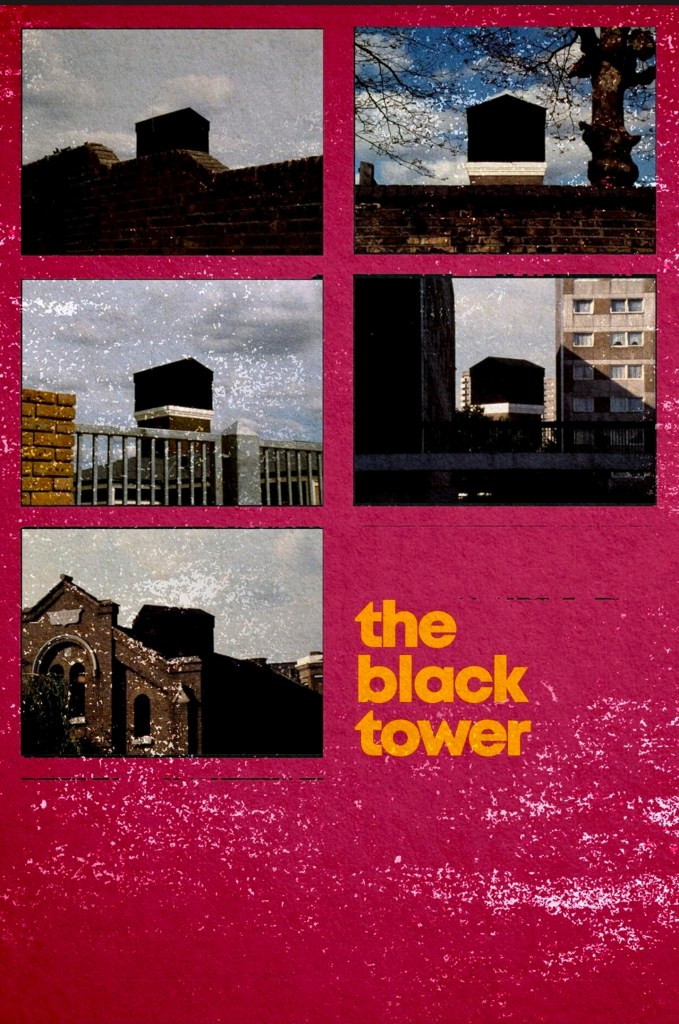
Dont let me over sell it. John Smiths seldom discussed 1987 oddity, The Black Tower, begins in the least cinematic way possible.
Not with a murder. Not with a revelation. Not with some theatrical piece of horror designed to drag the viewer in by force. It begins with a man describing the small dead routines of ordinary life. Shopping. Cooking. Washing up. The kind of flat domestic sequence that should reassure you that the world is intact. Then, while all this goes on, the tower starts appearing. A black shape over rooftops. Between buildings. Beyond walls. In the distance at first, then later with a persistence that becomes impossible to shrug off.
The tower is not introduced like a monster. It arrives the way real wrongness usually does into each of our daily lives, quietly, inconveniently, mixed in with the ordinary. The narrator notices it near home and is surprised he has somehow never properly registered it before. Then he forgets about it for a while. That detail matters. Depression and mental illness often enter life in exactly that way. Not as one dramatic event, but as something faintly off at the edge of things. A presence you do not fully understand at first. A shape that seems small enough to dismiss until you realise it has started organising your thoughts without your permission.
From there the film tightens the screw with miserable precision. The narrator sees the tower again and again from places where it should not quite be. He asks around. Nobody gives him the answer he needs. People either do not understand what he means, or they smooth the whole thing over into something more manageable. For a moment there is even the false hope that the tower might have been demolished, only for that relief to collapse. It is still there. Or rather, it is still there. By that point the tower is no longer just architecture. It has become a condition.
Part of what makes the film so unnervingly British is the fear is not simply that the tower is following him. It is that he is being forced into the role of the unreasonable man. The awkward man. The man who keeps insisting something is wrong when everyone else seems content to carry on as if the skyline is behaving perfectly normally. British horror is often strongest when it traps somebody inside manners, and The Black Tower understands that down to the bone.
In Britain, landmarks do more than decorate the background. They help you know where you are. We do not inhabit space in the clean American myth of numbered blocks and obvious grids. We do it through shapes on the horizon. A church tower above terraces. A block rising over trees. A chimney, a viaduct, a pub sign, something fixed that quietly steadies the eye. These things are part of the worlds furniture. You trust them without thinking.
So when one of them stops behaving properly, it is not just eerie. It feels like betrayal.
Understandably, for this reason the film works so well as a portrait of mental illness. The tower is not simply ominous. A moving landmark corrupts orientation. The very thing that should help the narrator place himself in the world starts unplacing him. Depression often feels exactly like that. Not just sadness, but a more total derangement of relation. Places stop feeling neutral. Routines stop helping. The world you knew does not vanish, but it no longer holds together in the same way. It is like coming home and finding that everything in the house has been moved half an inch to the left. You might not be able to prove anything. You might not consciously clock each change. But some older, more animal part of you would know that the room had stopped keeping faith with you.
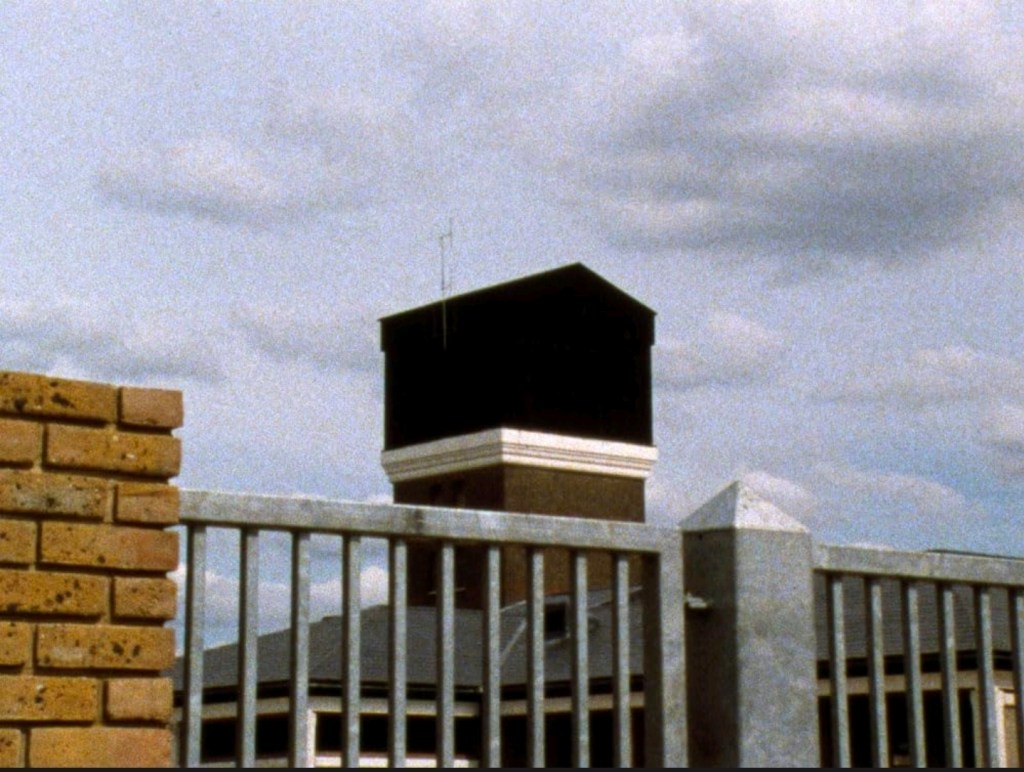
That is the films real subject. Misalignment. Spatial betrayal. The pressure of something remaining almost normal while becoming unusable.
The cheap British film grain deepens that feeling enormously. A glossier version of the same idea would lose half its power. The roughness of the image gives the film the texture of accidental evidence, as though this were not some polished art object but a shabby little record of a life quietly coming apart. Terraces, scrubland, back streets, bits of city that look neither beautiful nor dramatic, just ordinary and slightly worn down. The tower appears within that texture like an infection inside familiar tissue. Because the image is so plain, the disturbance feels more believable. The film is not straining to create atmosphere. It just has it, the way old British television and cheap film stock often did by accident.
That matters because the premise is, on paper, faintly absurd. A man is haunted by a tower. There is a dry joke built into that. John Smith clearly knows this. But the absurdity actually strengthens the depression reading rather than weakening it. Mental illness so often humiliates the person experiencing it because what they are dealing with sounds stupid when reduced to a sentence. A dread of going outside. A certainty that something is following you. A fixed idea you cannot dismiss even while part of you knows how it sounds. The problem is not only the suffering itself but the embarrassment of trying to describe it in public language.
The film is as much about social reality as private collapse. One begins to suspect that other people may well have noticed the same wrongness and simply chosen the standard British response, which is to pretend otherwise. Do not make a fuss. Do not say the strange thing out loud. There is something deeply plausible in the idea that the narrator is not the only person seeing the tower in impossible places, only the only one unable to cooperate with the lie. If so, the real punishment is not merely being haunted, but being the one person honest enough to admit it.
That is also how depression can feel. Everyone carries on. Everyone goes to work, makes tea, chats, asks polite questions, acts as if the room is normal. Meanwhile you are left with the unbearable sense that something fundamental has shifted and that you are the only one who cannot stop noticing it. Public reality becomes a performance you are too unwell to join properly. “Dont bring attention to it or else he’ll know we’ve been talking about him!” is something we’ve all encountered from one side or the other.
As the tower keeps returning, the narrator does what people do when their world starts slipping out of line. He narrows his life. He tries avoidance. He becomes hunted by recurrence. The tower does not need to run after him. It only needs to keep appearing. That is what makes it such a precise image of depression. Depression rarely arrives like a knife. It arrives like recurrence. The same thought. The same heaviness. The same return of the same dark shape, in the same mind, on another day when you had hoped to be free of it.
Then the film makes its cruelest move. The narrator collapses and is admitted to hospital, and even there the tower appears. The devastating turn removes the last comforting excuse. Up to then, one might tell oneself that perhaps this is all urban strain, loneliness, overattention, a mind worn down by repetition. But once the tower enters the hospital too, the place meant to separate him from the obsession becomes part of the same poisoned world. That is exactly how mental illness feels at its bleakest. Help does not feel like an outside. Treatment does not feel cleanly outside the illness. The thing has already got into the grammar of existence itself.
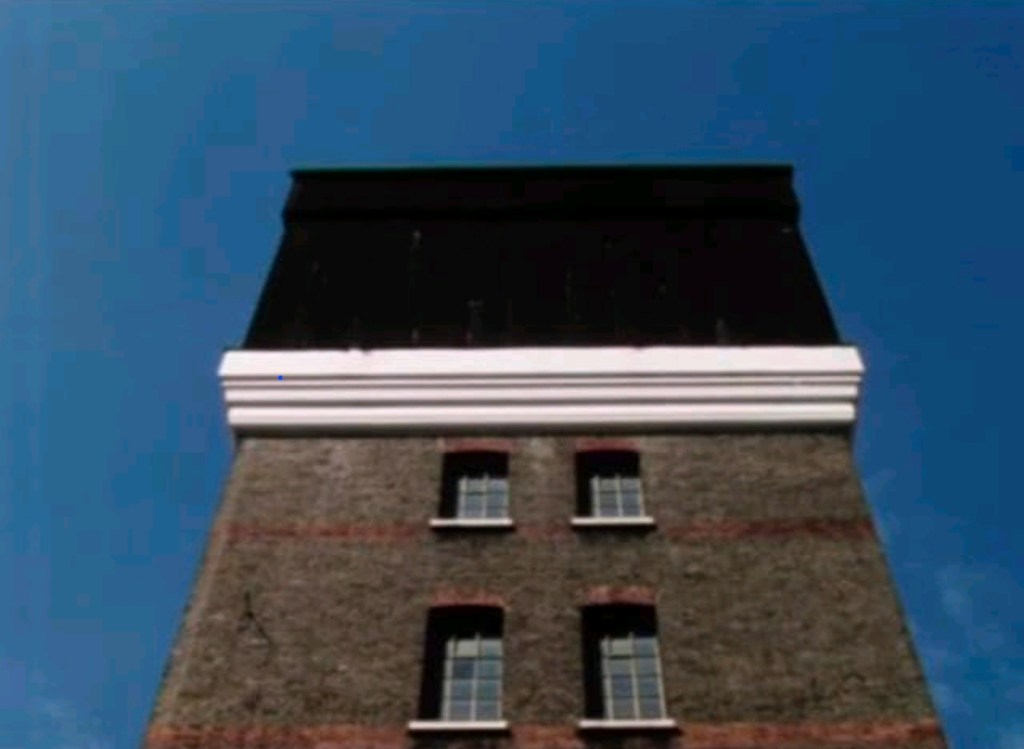
The countryside sequence is just as merciless. In another kind of film, leaving the city would bring relief. Fresh air, open space, a pastoral reset. The Black Tower denies that comfort. The tower turns up there too. By then the message is brutal and clear. The problem is no longer location. The problem is that the darkness has become portable. People often imagine relief from their troubles and work as geographical. A holiday. A different town. A break away. A quiet weekend. Time off. And yet the mind comes with you, like bad weather packed in the suitcase.
The ending is superb because it refuses any cheap rescue. The narrator finally approaches the tower itself. After all the glimpses and reappearances and impossible sightings, he reaches it, finds a door, opens it, and steps into darkness. That is one of the bleakest images in British short film because of how plainly it is handled. No grand revelation. No explanatory speech. No sudden solution. He just goes in.
As an image of surrender to mental illness, it is devastating. The tower is no longer merely watching him. It has become the final destination of his attention. All the way through the film he has been trying to orient himself against it, around it, away from it. In the end he does the opposite. He enters it. He yields to the thing that has been organising his world. It is hard not to read that darkness as the point at which depression stops being an intrusion and becomes total environment.
Then the film twists the knife one last time. A womans voice takes over. She visits his grave. And then the tower appears for her too. That final movement is crucial, because it stops the film becoming a simple case study of one mans private collapse. Instead the tower survives him. The wrongness continues. The darkness is not solved by his death. It is still out there, waiting to enter somebody elses field of vision.
The read of the film as hauntological in a richer sense than the usual obvious route of old media or lost futures. Here the haunting is not a message from the past. It is a recurring distortion in reality that survives individual lives. A stain in perception. A black shape that keeps returning and turns the ordinary world against whoever notices it too clearly. Depression can feel exactly like that, not an event, but a recurrence. Not a single breakdown, but a dark form that waits at the edge of things and keeps reappearing until the world itself seems subtly built around it.
What stays with you after The Black Tower is not just the image of the structure. It is the horrible possibility that madness and politeness may live side by side more often than we like to admit. That many people may sense that something is wrong and simply decide not to say it. That the person who speaks up is the one declared unstable. And that mental illness, like the tower, becomes most powerful when it can isolate the sufferer inside an experience that everybody else is too well mannered, too frightened or too socially trained to name.
A ghost in a house is easy enough to understand.
A landmark that should help you get home, but instead becomes the shape of your own unraveling, is much worse.


Leave a Reply