It is the first weekend of May. But how do I write about a critically acclaimed, iconic masterpiece that has already been dissected, scrutinised and analysed many thousands of times since it’s release?
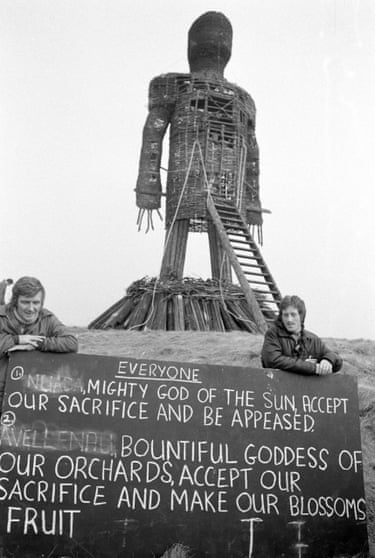
Most writing on The Wicker Man feels oddly house trained. It pads up to the film, clears its throat, mentions paganism, repression, sexuality, sacrifice, and then backs away as though it has done a respectable day’s work. A neat little parcel tied with folk ribbon. But The Wicker Man is not neat, and it is not really about paganism in the quaint sense people often mean it. It is about a society that has already made up its mind. Robin Hardy’s film is frightening because Summerisle is not disordered. It is settled. The songs are settled. The smiles are settled. The rituals are settled. Even the children already know what the world means. By the time Sergeant Howie arrives, he is not entering a debate. He is walking into a verdict. One that was decided months ago.
That is the first important distinction. Summerisle does not behave like a place wrestling with belief. It behaves like a place that has swallowed belief whole and turned it into weather. Nobody on the island seems especially troubled by what they think. Nobody is stumbling around in search of truth. They have truth already, boxed, labelled and humming in chorus. Howie arrives as a policeman, but his real role is closer to an auditor from another moral economy. He comes carrying a rival order in his head, one built from law, Christian duty, chastity, and the old assumption that even wayward communities can be pulled back toward the centre by a firm enough voice. Poor bastard. Summerisle has no centre left to return to. It has built another one.
Plenty of horror depends on chaos. Something gets loose. Something ancient wakes. Something crawls out of the walls and makes ordinary life impossible. The Wicker Man goes the other way. Nothing has got loose here. Everything is in its proper place. That is the problem. The inn functions. The school functions. The processions function. The local aristocrat functions. Even the jokes function. Summerisle is a working society. It has only arranged itself around a logic that leads, with perfect composure, toward murder.
That is far nastier than simple savagery. Savagery is at least honest enough to look the part. Summerisle has hospitality. Summerisle has music. Summerisle has a schoolteacher explaining reproduction with the ease of a woman discussing weather patterns. Summerisle has fruit orchards, bright clothes, sea air, children dancing around poles, old songs floating from pub walls. It looks less like hell than like a village event put together by people who really know how to delegate. The place does not leer at Howie. It welcomes him. Then it slowly reveals that welcome can be another form of containment.
People often talk about the clash between Christianity and paganism as though the film were simply setting one creed against another. That is true up to a point, but it still gives the thing too much politeness. Howie is not merely confronting another religion. He is confronting a complete social script. Sex is not private appetite. It belongs to fertility. Education is not neutral. It belongs to continuity. Celebration is not spontaneous joy. It belongs to order. Even failure is not allowed to remain plain, miserable failure. It must be interpreted, ritualised, fed into the machinery until it comes out wearing a sacred mask. Once a community starts doing that, facts lose their vote. And that is where the film stops being an elegant oddity from 1973 and starts grinning at the present. We still live among institutions that behave in exactly this way, only with fewer animal masks and more spreadsheets. Councils drag half dead schemes back into daylight, dust them off, change the branding, and present them again as though the problem last time was simply an insufficiently optimistic leaflet. Companies keep ramming life into dead systems because the greater embarrassment would be admitting that the software, strategy, training model, reorganisation, or grand managerial vision never worked in the first place. The machine coughs black smoke, drops pieces of itself across the floor, and some cheerful idiot in a lanyard announces phase two.
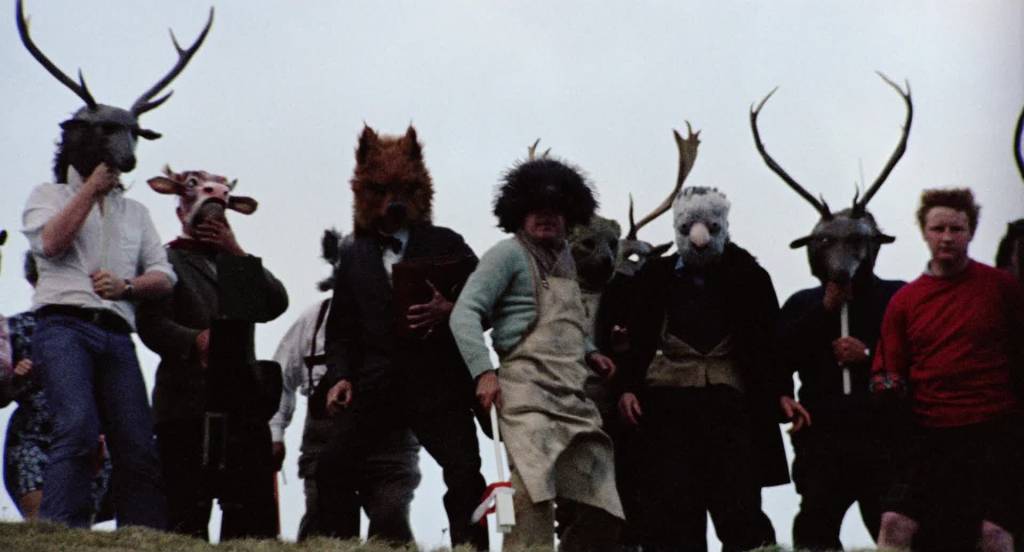
Summerisle would understand that instinct perfectly. Lord Summerisle cannot merely say the agricultural experiment has gone wrong. Men like him almost never say that. He cannot shrug and admit the crop failed, the soil disappointed, or the theory was vanity dressed as vision. Doing that would wound the mythology around his authority. So the failed orchard must become more than failed orchard. It has to be translated upward into belief. The land is not unproductive. The land is displeased. The result is not a miscalculation. It is a spiritual rupture. Once the failure of a system becomes sacred language, somebody will eventually be asked to pay for it in skin and bone.
That is where the film becomes wickedly intelligent. Human sacrifice is usually imagined as the high water mark of primitive frenzy. Drums, panic, ecstatic violence, eyes rolled white. The Wicker Man presents it more like the outcome of a well run committee. There is music. There is ritual. There is public participation. There is costume. But beneath all of it lies the eerie smoothness of a community that has already agreed the paperwork. Nobody appears particularly tortured by the moral stakes. Nobody needs persuading in real time. There is no last minute crisis of conscience. Summerisle has reached that stage every institution secretly dreams of, a state in which the story is so complete that cruelty can proceed without needing to raise its voice.
Howie matters because he cannot read that at first. He sees indecency, irreverence, blasphemy, and provincial perversity. He is partly right, but in the shallow way a man can be right about the wallpaper while missing the structure of the house. He is so bound to his own ideas of purity that he mistakes the island’s brazenness for looseness. But Summerisle is not loose. It is disciplined to the marrow. Its permissiveness is managed. Its sensuality is social. Its erotic life still serves the harvest, the ritual, the continuity of the place. The island has not escaped repression. It has simply repackaged it as seasonal good cheer. It has put flowers in the barrel of the gun. And that makes the film far more poisonous than the old prude versus free spirit reading people keep dragging out. Howie is rigid, proud, often insufferable. The film knows this and enjoys it. Edward Woodward gives him the air of a man who has been personally insulted by the existence of acoustics in the wall next door. Yet the island is no healthier for all its songs and flesh. It remains a place where bodies are assigned meaning from outside. Virginity matters. Fertility matters. Symbolic fitness matters. People are useful insofar as they serve the story the community tells itself. Summerisle does not offer freedom. It offers incorporation.
That is the word that hangs over the whole film like woodsmoke. Incorporation. The person disappears into the pattern. Children are taught through it. Women are framed through it. Men are judged through it. Desire is channelled through it. Failure is explained through it. When Howie arrives, he still thinks of himself as a moral subject, a Christian officer with agency, judgement, and a soul answerable to God. Summerisle sees something else. Summerisle sees criteria. Virgin. Outsider. Authority. Fool honest enough to walk into the trap believing he is the one asking questions. Total systems love a man like that. He brings his own symbolism.
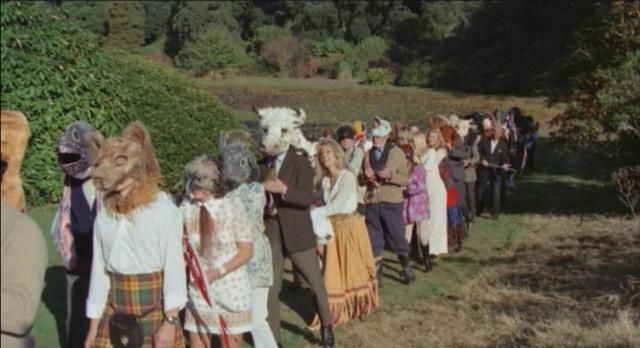
The music does much of the island’s real work. Without it, Summerisle might feel merely doctrinal. Songs make it intimate. Songs make it breathable. Songs make consensus feel like pleasure. A sermon can be resisted. A tune can be absorbed before you realise you have opened the window. The soundtrack is not just one of the film’s pleasures. It is one of its weapons. The community sings itself into coherence. It croons its worldview back into place. It harmonises over its own appetite until appetite sounds like tradition. You can hear the island persuading itself as it goes. That gives the film a hauntological charge far stronger than simple folklore nostalgia. Summerisle is not haunted by leftovers. It is haunted by continuity. The old world has not lingered in fragments or decorative traces. It is alive, organised, and still issuing instructions. There is something more unnerving about that than any amount of ruin. A ruin cannot command you. A ghost story in an empty house can be shut out with daylight. Summerisle has daylight in abundance, and still the past sits there in full public view, running the school, pouring the drinks, writing the rules. A ghost with a timetable is a much more serious matter.
The brightness of the film is half the wound. No crumbling castle. No black corridor. No expressionist thunder rattling the windowpanes. Hardy gives us open skies, beaches, inns, dancing, harvest imagery, children’s voices, and the sort of public festivity that usually belongs in a tourist brochure or on a tea towel. The horror arrives sunlit. That matters. It denies the viewer the comfort of obvious menace. Summerisle does not look diseased. It looks content. And contentment, when shared widely enough, can be one of the darkest atmospheres in cinema. Not because happiness is sinister in itself, but because a whole community pleased with its own logic is much harder to interrupt than a community in open crisis.
There is also something deeply British in the way the film handles power. Not in the twee sense. Nothing to do with bunting and scones and all that anaemic postcard rubbish. British power often prefers custom to confession. It likes appetite dressed as duty. It likes hierarchy passed off as inheritance. It likes violence softened by ritual language until it sounds almost neighbourly. Summerisle pushes this into nightmare, but the reflex is familiar enough. A tradition survives because it has survived. A rule remains because questioning it would feel rude, disruptive, ungrateful, somehow improper. Before long, nobody can tell whether the ritual exists because it is necessary or whether it is considered necessary because too many people have built their authority on performing it.
That is the real horror in The Wicker Man. Not merely a pagan island, not merely a Christian martyr, not merely the famous final image blazing against the evening sun. The horror lies in the unanimous smile beforehand. In the songs. In the lessons. In the way every conversation pushes Howie toward a conclusion already chosen for him. The community has made up its mind long before the wicker man comes into view. The ending does not reveal sudden madness. It reveals consensus finally becoming visible.
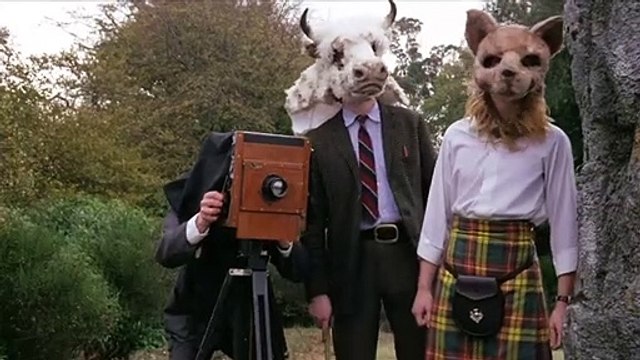
And that is why the film still bites. A society does not need fangs to be monstrous. It only needs enough shared belief to turn failure into ritual and people into solutions. We still see it everywhere. A broken institution clings to its own mythology rather than admit the obvious. A council keeps breathing into a corpse of a plan because no one senior wants to stand beside the body and own it. A company demands one more sacrifice from the staff because the greater sin, in managerial theology, would be saying the system itself is absurd. The orchard fails. The story must not. Somebody lower down will have to make up the difference.
By the time Howie is hauled into the wicker man, the murder has already taken place in the mind of the island. The fire is only the receipt.
Summerisle cannot bring himself to say the system is rotten, so someone burns.


Leave a Reply