The Hazelnuts sound so much like an old vocal group that the resemblance becomes unsettling for the wrong reason.
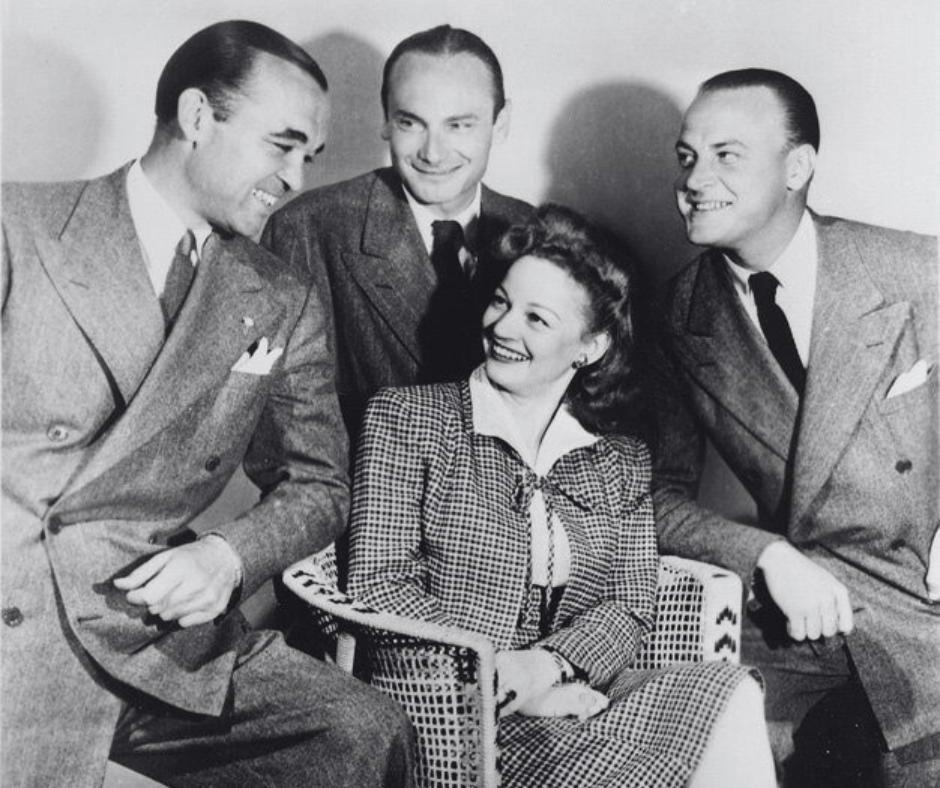
Nothing obvious is missing. The close harmony is immaculate. The vowels are rounded without turning into fancy dress. The phrasing has the small, deft bounce of singers who understand that rhythm can live inside a consonant. They never sound like three modern women who found a picture of the Andrews Sisters and immediately bought matching shoes. They know the language. Better than that, they know where the language breathes.
Yet something refuses to arrive.
Listen to The Pied Pipers singing “Dream”, then put on The Hazelnuts’ “Tempted”. The family resemblance is clear enough to cause administrative problems. Both songs float on close harmony. Both have that pale, suspended sweetness associated with American vocal groups of the 1940s. Both can make romance feel like a room seen through frosted glass. The singers are technically equal to the material. Nothing sounds clumsy, cheap or second hand.
Still, “Dream” is lonely in a way “Tempted” cannot quite reach.
“Tempted” sounds like three women singing beautifully about loneliness.
“Dream” sounds like loneliness has learned to sing.
I first heard The Pied Pipers through their recordings with Johnny Mercer. (Personality is one of my favourite songs od all time.) In those songs they seemed sociable, polished and amused by the world. Mercer occupied the centre, flicking words around like cigarette ash, while The Pied Pipers stood behind him furnishing the air. They could sound light without becoming flimsy, clever without nudging the listener in the ribs. Their harmonies made Mercer seem surrounded by unusually musical friends who had all agreed, after several drinks, to speak at the same time.
Then “Dream” arrived and the room emptied.
The voices remained. The warmth remained. The precision remained. Yet the people had somehow gone.
The song begins like consolation offered by somebody who has already left. It tells you to dream when you are feeling blue, to call up old memories and wait for them to soften the edges of the present. There is no melodrama. Nobody falls to their knees. No door slams. The lyric behaves like a small domestic instruction, the emotional equivalent of placing a hot water bottle beneath the sheets.
Underneath that gentleness sits a fairly bleak proposition. Reality has failed to provide what you need, so try memory instead.
The song never names the missing object. It could be a lover, childhood, home, safety, peace, a dead parent, a version of yourself who still believed the future was being arranged in your favour. The blank remains open. Every listener brings their own furniture.
The Hazelnuts’ “Tempted” travels close to the same place. The voices have the same floating quality. The arrangement keeps its shoes off. Desire appears softly, almost apologetically, then turns into disappointment before the song has fully settled. The sadness is restrained, which helps. Nothing ruins period harmony quicker than a singer attempting to demonstrate that she has emotions by dismantling the microphone.
“Tempted” has elegance, control and genuine melancholy. The trouble is that its sadness still belongs to somebody.
There is a woman in the song. She has been tempted. A smile has affected her. A romantic possibility has appeared and failed. We can picture the event. We can understand the emotional sequence. We may sympathise with her, though we remain spectators.
“Dream” removes the event and keeps the ache.
That difference opens the trapdoor.
The Hazelnuts can recreate the vocal style, but style is only the visible part of an old recording. Beneath it lies an entire lost arrangement of time, technology, expectation and cultural weather. The singers can rebuild the melody. They cannot stand inside 1944 without knowing what happened next.
The Pied Pipers did not sound vintage when they recorded “Dream”. They sounded current.
No historical haze surrounded their diction. Their microphones were not retro equipment. Their clothes were not costumes. Their harmonies were not a tribute to a vanished age because the age had not yet vanished. They entered a studio and made contemporary popular music for contemporary listeners.
The absence of revivalist self consciousness gives the record its cleanest cut.
The Hazelnuts sing an old language beautifully, but they know it is old. We know they know. They know we know. Nobody is guilty of fakery. The knowledge simply sits in the room, quiet as a fourth singer.
Every revival carries this extra body.
The performer can approach the period with scholarship, affection and instinct. She can avoid parody. She can resist cheap crackle, novelty accents and the usual antique shop rubbish. She may reach astonishing accuracy, but accuracy remains visible. We admire the reconstruction. We notice the craft. Part of our attention stays outside the song, comparing surfaces.
The Pied Pipers never had to convince anybody that they sounded like The Pied Pipers.
They were spared authenticity.
That word has become a strange burden in modern culture. A new recording inspired by the past must prove its credentials. The microphones, clothes, harmonies, instruments and phrasing stand trial. Reviewers inspect the stitching. Listeners applaud when nothing modern pokes through.
The old record had no such hearing. It simply existed before the evidence disappeared.
“Dream” therefore arrives without quotation marks. It does not say “1940s close harmony”. It is close harmony from the 1940s. The difference resembles the gap between a childhood photograph and an actor recreating your childhood photograph with tremendous care. The actor may stand in the correct garden, wear the same jumper and reproduce your expression exactly. The result could be flawless.
It still lacks the fact that nobody in the original photograph knew the photograph would become sad.
That is the weather The Hazelnuts cannot reproduce.
Hauntology begins where nostalgia stops behaving itself. Nostalgia wants the past returned in recognisable form. Hauntology notices that the form has returned without the world that made it ordinary. The object survives, but its original future has been cancelled.
An old record contains people moving toward a tomorrow that has already happened to us.
That gives every cheerful voice a second life. The singers may sound carefree, romantic or amused. We hear those emotions alongside the knowledge that their world continued without them, then vanished. The microphone captured a present moment and accidentally preserved its ignorance.
Nobody in “Dream” knows that we will listen decades later through wireless headphones, perhaps while walking past a vape shop, a betting shop and a phone repair kiosk. They do not know that their modernity will become our spectral wallpaper. They do not know that their voices will one day sound like transmissions from an impossible country.
The Hazelnuts know the old country is gone. Their music begins after the funeral.
They can visit. They can study the roads. They can rebuild a house on the original foundations. They cannot make the neighbours unaware that the motorway is coming.
This knowledge alters even the sweetest harmony. The Hazelnuts sound present. Their voices have bodies. One can imagine the singers facing one another, listening, adjusting, enjoying the blend. The music may be old fashioned, but the act of making it remains accessible. We can picture another recording session.
The Pied Pipers sound less recoverable. Their bodies have thinned into the medium.
On “Dream”, the lead voice floats above the lower harmony while the others form something closer to atmospheric pressure than accompaniment. You can hear singers, certainly, but the group identity has begun to dissolve. The voices do not simply support the melody. They extend the room behind it.
The male lower parts are important here. The Hazelnuts, as a female trio, produce a close, bright, beautifully integrated colour. Their voices gather in one area of the spectrum, weaving around one another like light through net curtains. The Pied Pipers place a female lead above male voices whose depth creates an acoustic horizon.
Those lower voices are not dramatic. They do not rumble like monks guarding a crypt. They remain soft, almost domestic. Yet they give the lead somewhere to recede into.
June Hutton sounds close and far away at once.
The effect resembles seeing a lit upstairs window across a field. The light is clear. The person inside remains unreachable.
The Hazelnuts tend to stand in the same emotional foreground. Even when the harmony thickens, the singers remain identifiable as people sharing a performance. Their blend is intimate.
The Pied Pipers’ blend is remote intimacy, which sounds contradictory until an old record does it to you.
They feel close enough to comfort and too distant to answer.
Recording technology helps, though it does not deserve all the credit. Old recording equipment has become the first suspect in any discussion of spectral music, usually arrested alongside tape hiss, mono sound and a suspiciously convenient gramophone. Modern producers can recreate all of these within minutes. Some do so with restraint. Others make every track sound as though it was recovered from a biscuit tin at the bottom of the Atlantic.
Surface damage does not create memory. It creates surface damage.
The loneliness of “Dream” survives beneath the noise. Clean the recording and the feeling remains. The ghost is not hiding in the crackle, waiting to jump out whenever somebody fries bacon nearby.
What the old recording process does provide is uncertainty.
The voices and orchestra share space. Their edges bleed into one another. The listener cannot inspect every part separately. The lower harmonies become less like isolated tracks and more like depth within a single event. The clarinet does not feel pasted onto the arrangement. It emerges from the same air.
Modern recording places sound under bright light. Each voice can be captured, corrected, balanced and displayed. Detail becomes a virtue. Breath has texture. Pitch has polish. The listener hears the beauty of three individual singers forming a chord.
On “Dream”, one hears the chord first and has to imagine the bodies.
The imagination enters where fidelity withdraws.
An old recording does not give the ear everything. Frequencies disappear. Room dimensions remain vague. The exact distance between singer and microphone cannot be reconstructed. The sound arrives incomplete, and the listener unconsciously repairs it.
That repair is personal.
The missing frequencies become imagined warmth. The blurred room becomes an invented studio. The singers acquire faces from photographs, films or nowhere. We lean toward the record, filling gaps it never asked us to fill.
A modern recording can sound more intimate while requiring less intimacy from the listener.
Everything is present. No rescue mission is needed.
“Tempted” sounds lovely through headphones because the voices arrive with clarity and physical closeness. “Dream” sounds lonely through headphones because the headphones fail to close the distance.
The recording remains elsewhere.
That elsewhere is difficult to manufacture. Put a modern singer through an old microphone and she remains a modern singer using an old microphone. Restrict the frequency range and she becomes a modern singer heard through a smaller hole. Add shellac noise and she becomes a modern singer whose neighbour is sanding a table.
The missing element is not degradation. It is separation.
“Dream” has been separated from its original listeners, its original broadcasts, its ordinary cultural surroundings and the casual familiarity that once kept it grounded. The song survives after its social world has disappeared. We encounter it alone, stripped of the adverts, radio chatter, domestic routines and current events that once made it merely one beautiful popular song among many.
The song has outlived its furniture.
The Hazelnuts release music into a world where the furniture remains visible. Their photographs, performances and recordings exist together. The group can be located, understood and contextualised. They have not been reduced to a few minutes of preserved air.
That reduction gives old recordings their strange authority. Time edits brutally. It removes the ordinary and leaves the artefact. The record becomes cleaner in cultural memory even as its physical sound deteriorates.
The Pied Pipers were once people with schedules, professional disagreements, tired mornings, travel arrangements and probably opinions about lunch. Almost none of that enters the modern listening experience. Their daily reality has fallen away. What remains is harmony.
The Hazelnuts are still attached to life.
This should count in their favour, though hauntology is rarely fair.
It prefers the abandoned building to the functioning one. It prefers the closed television station to the new streaming service recreating its idents. It prefers the school corridor during summer holidays, when the usual purpose has departed and the architecture begins remembering something on its own.
The Hazelnuts recreate the song form.
The Pied Pipers have become the closed building.
“Dream” carries another advantage. Its emotional language leaves room for contamination.
The lyric does not specify enough. The melody does not press hard. The arrangement avoids obvious dramatic signalling. The song remains soft, vague and inviting. Later listeners can pour their own historical unease into it.
A strongly defined song resists this process. It may describe a breakup, a death, a city or a precise event. We can admire it, identify with it and understand its emotional destination.
“Dream” provides a vehicle and removes the road signs.
Its title is already an empty container. A dream can comfort, frighten, distort, repeat or preserve. Dreams make the dead socially available for a few minutes. They return buildings that no longer stand. They allow childhood homes to contain rooms that never existed. They restore voices while quietly altering the face attached to them.
The song tells us to dream as though dreaming were uncomplicated.
Anyone who has dreamed of somebody lost knows otherwise.
The return is usually perfect for half a second. The person is alive again. Nothing requires explanation. Then a small wrongness appears. The room is unfamiliar. Their voice is slightly off. You begin remembering that they should not be there, and the dream collapses under the weight of its own generosity.
“Dream” carries that structure in miniature. It offers the past as relief while sounding like evidence that the relief cannot last.
The Hazelnuts’ “Tempted” looks backward musically, but its emotional action remains stable. We understand what happened. The song ends having expressed it.
“Dream” keeps opening after it ends.
The clarinet sees to that.
Calling the solo beautiful hardly touches it. The clarinet begins inside the arrangement, a familiar piece of dance band colour, then climbs until the instrument seems to lose its material source. Wood becomes light. Breath becomes altitude.
It sounds like the record briefly discovering space travel before anybody has brought the correct equipment.
The solo does not show off. It does not swagger into the song wearing a white scarf. It rises with almost indecent ease, as though gravity had always been optional.
That movement breaks the domestic scale of the lyric. We have been told to dream of remembered things, perhaps in bed, perhaps at night, perhaps during a lonely broadcast. The clarinet then lifts the memory beyond the room. It carries the song through the ceiling and leaves us looking upward.
The Bambi feeling enters here.
Old Disney music could make nature sound safe and deathly at the same time. A woodland chorus promised innocence, but the orchestra knew winter was coming. The animals might sing, dance and arrange flowers, yet something in the harmony suggested the forest had existed before them and would continue afterward.
“Dream” has the same sweetness at the edge of vacancy.
It feels suitable for a child without quite being safe for one. The melody could accompany sleep, snow, moonlight or an abandoned nursery. Nothing sinister happens. Sinister would be easier. The song remains kind.
Kindness from the dead can be unbearable.
The Pied Pipers do not frighten us. They comfort us from a place we cannot enter.
That is lonelier than fear.
The Hazelnuts can sound dreamy, but their dream has occupants. Their voices smile, react and shape the song. Even at their most restrained, personality remains present. One hears three singers choosing softness.
The Pied Pipers’ softness seems to exist before choice.
Their performance has the smoothness expected of professional popular singing from the period, yet modern distance has removed the effort. We no longer hear people deciding how to phrase the line. We hear the phrase preserved.
The song has escaped biography.
This anonymity adds to the loneliness. Modern singing often relies upon personality as proof of sincerity. We expect visible individuality. The singer should expose herself, confess, crack, whisper, break or otherwise demonstrate that the feeling has been officially registered.
The Pied Pipers offer composure.
The emotion remains inside the blend, never dragged forward for identification. Nobody says, “Look how wounded I am.” The sadness is too well mannered to make a fuss.
Good manners have aged into eeriness.
A polished voice holding pain at a distance can feel more desolate than a singer openly collapsing. Collapse provides release. Composure keeps the room intact.
“Dream” never breaks its own spell. The singers do not wake. The arrangement does not deliver a cathartic surge. The clarinet returns from space without explanation. The final phrases settle gently, leaving the listener alone with the instruction.
Dream.
The word begins as comfort and ends as a sentence.
“Tempted” comes close through similar restraint. The Hazelnuts understand that sadness need not arrive carrying a bucket. Their harmony keeps the emotion light enough to float. The song never becomes self pitying.
Still, one senses a completed performance. The emotional object has been made, polished and placed before us.
“Dream” feels discovered.
This is another illusion produced by age. The Pied Pipers were not mysterious woodland spirits. They rehearsed. The arrangement was written. The recording was planned. Takes were made. Somebody watched the clock. Commercial music has always involved administration, even when later generations prefer to imagine everyone wandering into Capitol Studios during a thunderstorm.
Time removes the paperwork.
The result appears inevitable, as though the song had always existed and the singers briefly allowed it through.
Modern music arrives with its making visible. We understand recording. We know about editing, microphones, releases and alternate versions. We can picture process. The artefact does not fully detach from production.
Old music can become orphaned from process.
The less we know, the more the record seems to have recorded itself.
Hauntology loves such orphans. It gathers abandoned educational films, public information music, old television themes, library records and half remembered jingles because they have lost the institutions that explained them. Their original function remains detectable but incomplete. They continue signalling after the receiver has been removed.
“Dream” once had a clear function. It served as a closing theme on Johnny Mercer’s radio programme. That fact deepens the entire effect.
Closing music accompanies a disappearance.
The programme has ended. The hosts and musicians have occupied the room, then the theme begins and everybody prepares to leave. For listeners, the song marks the boundary between company and silence. The broadcast has filled the evening. Now the dial returns to static and the house resumes being a house.
“Dream” therefore carried absence from the beginning.
It did not need decades to become spectral. Every broadcast rehearsed its own death.
The Pied Pipers sang listeners out of a temporary shared world. Their voices promised consolation while withdrawing the source of consolation at the same moment. Goodnight. Dream. We will be here again, though not now.
Radio understood this form of intimacy better than almost any later medium. A voice entered private rooms without bringing a body. Listeners formed attachments to people they could not see, people speaking simultaneously to thousands while sounding personally near.
The medium created company out of distance.
When the broadcast ended, the distance returned.
Modern streaming rarely produces the same ritual. Songs remain available. Programmes wait. Nothing truly goes off air. Silence becomes optional. The voice can be summoned again before it has finished leaving.
Availability weakens disappearance.
The Pied Pipers belonged to a world where hearing a song could depend upon time, signal, ownership and accident. A listener might miss it. A broadcast might fade. A record could break. Music remained tied to events and objects.
The Hazelnuts live in a world where “Tempted” can be replayed immediately, searched, isolated, saved and carried everywhere. The song is less likely to vanish, which gives it less opportunity to return.
A ghost needs absence first.
Digital culture stores everything and remembers almost nothing. Its archives are vast, though few objects gain the pressure produced by genuine scarcity. We can recover the song whenever we choose. The emotional relationship becomes one of access rather than loss.
Old recordings reach us through survival.
Somebody kept the disc. A label preserved a master. A collector transferred it. A platform uploaded it. The chain may be invisible, but the listener senses age as improbable continuation. The recording has crossed years in which almost everything surrounding it was discarded.
“Dream” sounds lonely partly because it survived its audience.
The Hazelnuts have not yet had time to lose theirs.
Perhaps this comparison is less a judgement on the groups than a judgement on us. We ask modern musicians to create the emotional consequence of historical loss without permitting the loss itself. We want a record to sound as though it has travelled eighty years while releasing it on Friday.
The request is absurd.
The Hazelnuts can sing the harmony. They can soften the vowels. They can avoid modern pop excess. They can write songs with restraint, elegance and melodic grace. “Tempted” shows how near a living group can move toward the emotional climate of “Dream”.
The last few feet belong to death, media decay and cultural forgetting.
Nobody should hurry them.
Their failure to sound exactly as lonely may be evidence that the music still possesses a home.
The Pied Pipers no longer do.
Their voices have become detached from ordinary life and lodged inside our imaginative version of the past. We place them among dim radios, night trains, empty ballrooms, snow outside windows and wartime bedrooms, whether or not those scenes belong to the recording. The song absorbs every obsolete image offered to it.
It has become a screen for lost futures.
The people who first heard “Dream” imagined futures from their own present. They dreamed of peace, reunion, marriage, prosperity, safety, adulthood, returning home. Some of those futures happened. Others failed. All have now become past.
When we listen, we hear the future they expected and the history we know.
Both occupy the same chord.
The Hazelnuts cannot reproduce this double exposure because their future remains open. “Tempted” has not yet outlived the world that understands it. Its melancholy points backward within the song, but the recording itself still faces forward.
“Dream” faces both directions and belongs to neither.
That is the missing piece.
Not tape.
Not mono.
Not a clarinet, though the clarinet clearly knows more than it is saying.
The missing piece is the vanished future inside the old sound.
The Hazelnuts recreate a style whose original listeners believed it was leading somewhere. We hear the same style after arriving at the place it led. The road is closed behind us. The buildings have changed. The radio station is silent. The people singing cannot be told what became of their tomorrow.
Their innocence is not childish. It is chronological.
They simply do not know they are ghosts.
The Hazelnuts know ghosts exist. They have heard the records. They understand the shapes, the shadows and the old harmonic courtesies. Their music can invite the dead to the microphone, but the dead remain dreadful collaborators. They arrive late, refuse direction and take the best part of the song without appearing in the credits.
“Tempted” floats beautifully.
“Dream” floats after the string has been cut.
One gives us cloud nine.
The other gives us cloud nine with the hotel closed, the lift still running and a clarinet playing somewhere above the top floor.


Leave a Reply