Imagine cycling down a barely used road somewhere on the Welsh border and discovering that the countryside has become suspiciously perfect.
A river is trickling beneath a stone bridge with the sort of commitment to atmosphere normally associated with a BBC costume drama. Birds keep lifting from a wheat field, crossing the lane and disappearing into another hedge. Cow parsley leans over the verge. Somewhere beyond the next fold in the land, a tractor provides a distant mechanical hum without ever showing itself. The road has narrowed to a strip of tired tarmac with grass growing along the middle, and the last car passed long enough ago that you have stopped listening for another.
Your phone lost its signal several miles back.
Good.
The ride has reached that pleasant stage where the world has reduced itself to things immediately in front of you. The soft mechanical chatter of the chain, breathing, the next gradient, the occasional insect making a fairly committed attempt to enter your eye at twenty miles an hour. The last village consisted of a church, a postbox and several houses which appeared surprised to have been found.
Then something rises above the trees.
At first it looks like a crane.
Another hundred yards and it is still there.
Too high. Too thin. Too deliberate.
A mast.
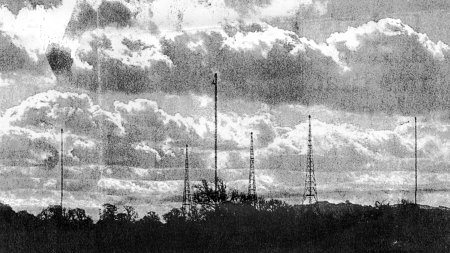
The road bends and it disappears. A few moments later it returns from another angle, an enormous piece of latticework climbing through a skyline which, until then, had contained nothing more technologically ambitious than telegraph poles.
There is no town beneath it. No industrial estate. No obvious reason for several hundred feet of metal to have been driven into this particular patch of countryside.
The birds continue with the wheat.
The river carries on beneath the bridge.
Only the sky has gone wrong.
That slight disturbance has become one of my favourite sensations on long rides. It is not fear, although some of these structures are very good at borrowing the appearance of places where questions are discouraged. Usually the explanation is harmless. Broadcasting equipment, telecommunications, astronomy, some minor utility whose day to day operation probably involves less espionage than an argument about whether somebody has ordered enough printer toner.
Still, the landscape has betrayed itself.
You thought the place was empty.
It was merely quiet.
Occasionally the revelation is smaller. The phone which has been useless for half an hour suddenly wakes in your pocket and announces that WiFi is available.
No houses are visible. No pub. No campsite. No row of holiday cottages with SHEEP123 laminated beside the kettle.
There is only a locked gate and a thin access road disappearing through the trees.
The signal strengthens as you approach.
Then begins to fade.
Half a mile later the network has vanished.
The explanation will probably ruin it. A maintenance building behind the ridge. A farmhouse hidden by trees. Some piece of network equipment broadcasting slightly further than intended. Nevertheless, for thirty seconds you have ridden through the edge of an invisible room.
After enough encounters like this, the British countryside starts to look different.
The familiar idea of rural Britain depends upon a kind of selective editing. Stone walls are acceptable. Telegraph poles have been standing around for so long that they have acquired heritage status by exhaustion. Corrugated agricultural sheds eventually rust into the scenery. A huge radio mast is more troublesome. So is a concrete building with no windows sitting half a mile from the nearest house.
The twentieth century put a remarkable amount of machinery into landscapes which continued looking ancient around it.
The Welsh border does this particularly well. Around Shropshire and Powys the roads disappear into folds of land, villages gather tightly around old churches, and hills seem capable of swallowing entire settlements. It is easy to convince yourself that modernity reached some of these lanes, took one look at the gradient and went home.
Then you discover Criggion.
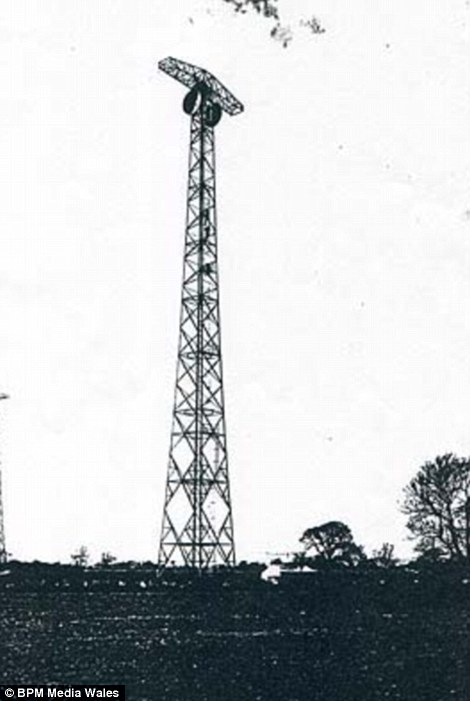
The great masts are gone now, which somehow makes the place stranger.
For much of the twentieth century an enormous radio transmitting station occupied the plain beneath the Breidden Hills. Criggion had been developed during the Second World War after the Admiralty recognised the danger in relying on the VLF transmitter at Rugby, which was strategically important and vulnerable. Criggion later became deeply involved in long distance radio work, including naval communications, and its GBZ service transmitted messages to submarines until the station closed in 2003.
Look at photographs of the site in operation and the scale feels almost impolite.
The landscape is recognisable as the border country it remains today. Fields spread beneath the hills, the sky hangs enormous above them, and through the middle rise great radio structures which appear to have been drawn over the photograph with a ruler. Some of the later masts reached more than two hundred metres.
Imagine living underneath them for years.
Eventually they would cease being strange.
That fascinates me more than their construction ever could.
A child grows up seeing them from a bedroom window and never considers that other children do not have giant naval communications infrastructure puncturing their horizon. Someone walks a dog beneath them. Someone else drives past worrying about shopping. A farmer pays more attention to rain than to the colossal aerial system beyond the field.
The extraordinary becomes local furniture.
Yet the purpose remained wonderfully disproportionate to the setting.
A wet lane near the Welsh border.
A transmitting station beneath the hills.
Somewhere far away, a submarine under the Atlantic.
Invisible information passing between them.
There is something almost quaint about the sheer physical size once required to make communication disappear. Modern communication arrives without revealing its route. A message reaches a phone and gives no clue how many cables, exchanges, towers or servers have been involved. Criggion belonged to an age when invisible signals still required very visible architecture. The radio message might weigh nothing, but the machinery needed fields.
Then the machinery went.
The station closed and the great masts came down.
The hills remained.
The fields remained.
The skyline apparently returned to normal.
Except old photographs make that impossible. Once you have seen Criggion with the masts standing, the empty sky contains their absence. You begin putting them back mentally, as though the landscape has been badly restored and someone forgot an entire layer.
This is the point where cycling through old technological landscapes becomes oddly temporal. The road beneath you is entirely present. The thing beside it might belong to 1943. A concrete base can sit quietly in grass while the system which required it has vanished so completely that explaining its purpose takes twenty minutes.
The past here is rarely grand enough to announce itself.
It leaks through.
A few miles further into the same border country, the trick repeats itself in an entirely different form.
You see a white curve above the hedge.
At first there is not enough of it visible to understand what it is. The road rises slightly and more appears. Then the scale clicks into place.
A radio telescope.
The twenty five metre dish at Knockin forms part of e MERLIN, the radio telescope network headquartered at Jodrell Bank. It sits roughly eighty five kilometres from Jodrell itself, one instrument in an array spread across the country.
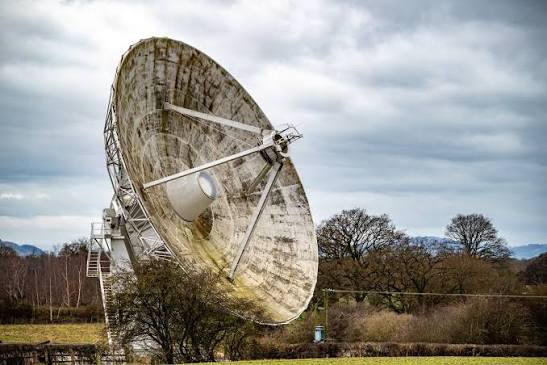
On paper, all perfectly sensible.
From a bicycle, less so.
Radio telescopes behave properly in photographs because the caption tells you how to look at them. A page about astronomy prepares the brain. There is the dish. It detects radio emissions. Very interesting.
A country lane provides no caption.
One moment there is a hedge.
Then an enormous white bowl is looking over it.
The scale fights everything around it. Barns and trees offer familiar measurements, while the telescope seems to belong to another system entirely. If the dish changes position while you are nearby, even slowly, the effect becomes stronger. There is no dramatic science fiction movement. It simply alters its angle with mechanical precision and becomes still again.
The countryside does not respond.
A tractor carries on somewhere nearby.
The machine has turned towards something unimaginably distant.
That contrast is almost comic. Life in the surrounding villages continues at a scale involving bin collections, potholes and whether the shop shuts at five, while a huge instrument among the fields listens to phenomena whose distances make the whole of Shropshire feel slightly provincial.
The telescope is entirely benign, yet it retains a faintly ominous quality because its attention is elsewhere.
That quality runs through much of this architecture.
A normal rural building belongs to the land around it. The farmhouse belongs to the field. The church belongs to the village. Their purposes sit nearby.
The telescope is physically in Shropshire while concerning itself with deep space.
Criggion stood among fields while speaking towards the sea.
The architecture is here.
Its mind is somewhere else.
Follow that idea north into Cheshire and it eventually becomes enormous.
The Lovell Telescope at Jodrell Bank has suffered slightly from becoming famous. We have seen it too often. It has become an emblem of British science, a convenient giant bowl to place behind anything involving astronomy. Familiarity turns extraordinary objects into logos.
Seen properly, it remains absurd.
The great dish hangs inside a structure large enough to compete with the sky. Even at rest it looks as though it is waiting for instructions from somewhere no human being can point to accurately.
Jodrell Bank began as a place for radio astronomy, but the Cold War found another use for it. After Sputnik was launched in 1957, the telescope tracked the rocket which had carried the satellite into orbit. The machine which had opened a new window onto the universe was also capable of tracking technology descended from the same ballistic rocket programmes transforming nuclear strategy. By the early 1960s Jodrell Bank had acquired a secret role in Britain’s missile warning arrangements. During the Cuban Missile Crisis, RAF personnel were ready to use the telescope to watch eastward for a possible long range attack.
It is a near perfect piece of Cold War absurdity.
Human beings finally build a machine capable of peering into distances which make our entire history look microscopic, then almost immediately ask whether it might also tell us if the Russians are about to kill everybody.
The telescope did not need to change appearance.
The same steel could contemplate galaxies and nuclear war.
The sky contained both.
This collision between scientific optimism and organised dread sits beneath a surprising amount of postwar British landscape. The technologies used to explore the future arrived at almost the same moment as the technologies which threatened to cancel it.
Some of the infrastructure was immense. Much of it was considerably more pathetic in scale, which makes it worse.
Across Britain, Royal Observer Corps monitoring posts were prepared for the possibility of nuclear attack. Small underground chambers, often positioned in utterly ordinary countryside, were intended to provide information about nuclear detonations and radioactive fallout. The network spread widely enough that an innocent patch of ground near a village could sit inside the machinery of Armageddon without looking much different from the field beside it.
The underground room is more disturbing than the missile.
A missile belongs to the theatre of nuclear war. It is suitably enormous and terrifying.
The room belongs to work.
Someone has to sit there.
An event beyond sensible human scale occurs outside, and the response inside is to take a reading.
That is the peculiarly British nightmare hidden beneath the grass. Nuclear war converted into procedure. The impossible reduced to information which can be passed along because somebody, somewhere, will presumably still be answering the telephone.
The old posts reveal the Cold War less through fear than through administration. Governments were required to imagine the country after attack, so familiar landscapes acquired a second identity. The field remained a field, but planning turned it into part of a network. The hill remained beautiful, but its elevation had practical value. Weather remained weather until the direction of the wind began deciding where fallout went.
Two versions of Britain sat on top of one another.
Most people lived in the visible one.
The other existed in maps, calculations and rooms beneath the ground.
Fylingdales made the hidden version impossible to ignore. On the North York Moors, the original ballistic missile early warning station appeared in the 1960s as three enormous white radomes, the famous golf balls, planted into one of the bleakest landscapes in England. The present phased array radar is different, but its purpose retains the same cold simplicity. The site formed part of the British and American system built to provide warning of intercontinental ballistic missile attack.
Warning, in the British imagination, eventually became those famous four minutes.
Four minutes is so short that strategy collapses back into domestic life.
You could still have half a cup of tea on the table.
A record might still be playing.
Someone would be upstairs.
The television would still be warm.
A few minutes earlier the evening had contained tomorrow.
Then somebody somewhere had detected something crossing the sky.
The architecture required to produce those minutes sat among moorland, rain and sheep.
The countryside seems almost offensively beautiful around places built for such thoughts. Perhaps that sharpens their effect. We expect terrible machinery to occupy terrible landscapes. Instead Britain put it beside villages, on hills and among fields because geography had practical advantages which scenery did nothing to cancel.
A place could be lovely and strategically useful without contradiction.
RAF Rednal, near Oswestry, carries a quieter version of the same doubling.
The airfield opened in 1942 and became home to No. 61 Operational Training Unit under Fighter Command, with large numbers of pilots trained on aircraft including Spitfires.
Stand around an old airfield today and the former noise can be difficult to reconcile with what remains.
Airfields are too large to disappear properly.
Buildings can be demolished and runways broken up, but geometry survives. A road remains suspiciously straight. A field meets another at an angle which makes more sense when seen from above. Concrete turns up where no farmer would have bothered putting it. Something about the landscape feels planned on a scale larger than agriculture.
Once you know the airfield was there, the old layout starts showing through.
The present becomes thin.
A road is no longer simply a road because another version of it has appeared underneath. The quiet becomes equally deceptive. What is now wind across open ground once contained aircraft engines, vehicles and hundreds of people arriving for work.
Military sites age awkwardly because they are not old enough to become picturesque.
A castle ruin knows what it is doing.
Give it some ivy and a gift shop and everyone understands the arrangement.
A concrete military building from 1943 remains annoyingly close to usefulness. The door still looks like somebody might unlock it. The window still belongs to an office. A corridor can sit empty for half a century without learning how to become romantic.
That gives abandoned RAF architecture an unsettling temporal flatness.
The war has gone.
The building seems less certain.
Somebody ought to be coming back after lunch.
Winter Hill achieves something similar without abandonment and without needing a military history at all.
The mast rises more than three hundred metres above Lancashire, one of those objects whose scale is easier to understand from miles away than from underneath it. Broadcasting from Winter Hill began in 1956, carrying the new commercial television service into northern homes. The present tall mast followed in the 1960s.
Approach it in poor weather and almost everything about the structure suggests defence.
The exposed hill, the fencing, the engineering buildings, the sheer height of the thing vanishing into mist. It has the demeanour of somewhere Britain would use to detect bombers.
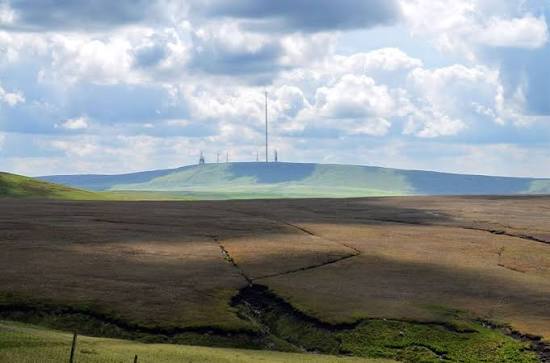
Instead, it broadcast Granada.
There is something magnificent about the disproportion.
Postwar Britain erected a structure of vaguely apocalyptic severity so that people could sit inside warm houses and watch television.
The mast carried regional news into living rooms. It carried entertainment across Lancashire. Whole evenings moved invisibly through the thing while the structure itself stood on the hill looking as though it knew where the missiles were.
Broadcasting once had geography in a way which is increasingly difficult to remember.
Television came from somewhere.
A mast served a region. Weather and terrain mattered. People adjusted aerials. Signals weakened. The landscape had places from which culture was physically emitted.
Millions of forgotten evenings passed through Winter Hill.
People watched programmes which no longer exist in houses which may no longer exist, receiving them through a transmitter which remains on the moor.
That gives broadcasting architecture a melancholy different from the military sites. The great Cold War installations were built in fear of a future that might arrive. The television mast carried a present which vanished anyway.
Both survive longer than the moment which made them important.
Modern digital life makes the machinery harder to see. A song appears when touched. A film begins. A message travels halfway around the world and arrives with no visible evidence that distance was involved.
Cycling restores some of that physicality.
Signal has terrain again.
A valley can silence the phone. A ridge brings it back. You pass beneath a mast and the abstract business of communication suddenly develops mass.
Then there are those inexplicable little pockets of WiFi.
Perhaps that is the modern version of seeing the edge of the old system.
You have been riding for an hour without useful reception. The road has become steadily narrower and the houses stopped some time ago. Woodland closes around one side. On the other, the land drops towards a stream.
The phone vibrates.
A network has appeared.
Nothing in the visible landscape has changed.
You ride another fifty yards and the signal becomes stronger.
Somewhere nearby, hidden by nothing more exotic than trees and topography, is a piece of the connected world.
The effect lasts less than a minute.
Then the road drops again and the signal disappears.
That tiny encounter does something the enormous installations also do. It reveals that remoteness and isolation are not the same thing. A place can look completely detached from modern life while sitting directly inside systems which extend far beyond it.
Once you know this, the countryside loses a little of its innocence.
It does not become sinister.
That would be too easy.
The beauty remains exactly where it was. The river still sounds absurdly idyllic beneath the bridge. Wheat still moves in the wind. Hills still produce that satisfying feeling of having escaped somewhere older and slower.
What changes is your confidence in the surface.
You begin to understand that the peaceful landscape has never been separate from the technological century. It was woven into it.
Criggion’s vanished masts belonged to the fields beneath them. Knockin’s dish still belongs to its patch of the Marches. Jodrell’s giant telescope could be astronomy one moment and part of nuclear anxiety the next without moving an inch. Rednal’s wartime geometry survived long after the aircraft disappeared.
The distinction between natural landscape and technological landscape starts to look increasingly artificial.
The countryside did not hide these things through camouflage so much as absorb them through familiarity.
That is a more interesting process.
A mast becomes normal because it has been there longer than you have. A concrete structure becomes part of a field because nobody remembers the field without it. Eventually the purpose goes and the object remains, stripped of the activity which once made sense of its shape.
What is left feels haunted because the architecture was built facing forwards.
Every installation contained an expectation.
People expected aircraft to keep using the runway.
People expected the transmitter to keep carrying signals.
People prepared underground rooms because a nuclear exchange remained conceivable enough to deserve real concrete, real money and real shifts.
Then time went somewhere else.
The future those structures were waiting for either failed to arrive or arrived in another form.
Nobody holds a ceremony when that happens.
The requirement disappears.
Budgets move.
Gates stop opening.
Grass approaches.
Years later a cyclist turns onto the road.
The site is quiet.
That silence can be misleading.
These places were full of ordinary human noise. People complained about shifts inside them. Someone arrived late. Someone wanted a cigarette. Someone had to find a key. Equipment broke at inconvenient moments. Even the most frightening infrastructure became a workplace once enough people spent enough mornings there.
The Cold War has acquired an aesthetic of control rooms and warning sirens, but most of it must have felt much duller from inside.
Somebody had to make tea while waiting to discover whether civilisation was going to continue.
That mundane quality is what makes the surviving architecture land so heavily now.
An abstract system does not haunt anything.
A room does.
A door does.
A road disappearing through trees does.
They place human beings back inside the history.
Perhaps this is also why deliberately visiting these places never quite produces the same sensation as stumbling across them.
Once something becomes a destination, the mystery is damaged.
You already know what will be there. You have read the history. The strange building appears precisely where the map promised it would and behaves itself.
The better encounter happens on the way somewhere else.
Take a road because it looks quieter.
Miss a turning.
Climb further than intended.
The last houses disappear.
By the time you realise you have gone rather a long way into nowhere, turning around feels more annoying than carrying on.
Then a shape appears above the next rise.
You cannot identify it yet.
For several minutes the road refuses to give you a clear view. The structure arrives between gaps in trees, then vanishes again. With every turn you get slightly more of it, never enough to understand the whole.
There is no plaque explaining what you are looking at.
No convenient paragraph.
Only the object and the landscape disagreeing with one another.
Eventually the road turns away and the structure disappears completely.
The ride resumes.
Later, curiosity will probably win. At home, with the bicycle against the wall and the day’s route still in your legs, the place name goes into a search engine.
The mystery becomes history.
Old photographs appear.
Suddenly the blank compound has people in it.
The empty track has vehicles.
The strange concrete acquires a date.
Knowledge rarely kills the atmosphere.
Usually it makes the whole thing worse.
The imagination tends to reach for something glamorous. Secret laboratories. Hidden command centres. Conspiracies.
Reality comes back with maintenance records.
That is much colder.
A secret bunker can contain anything until you discover that it contained a few ordinary people expected to stay underground after a nuclear attack and continue doing their jobs.
The ordinary details make the scale comprehensible.
Somebody sat there.
Somebody waited.
Outside, the scenario being prepared for was almost too large to imagine.
Inside, time still had to pass normally.
The British countryside is full of places where those two scales once touched.
Most are invisible unless you know where to look.
Some have disappeared completely.
Others still rise so far above the fields that missing them would require effort.
Yet after enough miles, it is no longer the enormous structures which produce the strongest feeling.
It is the possibility of something unseen.
Late in the ride, the road drops back towards another river. The light has started flattening out across the fields and there is that mild evening chill which appears before the sun has technically done anything wrong. The strange structure from earlier has been behind the hills for several miles.
Your phone still has no signal.
Then it vibrates.
WiFi available.
You glance down.
The network has a name which means nothing to you.
The signal is weak, then stronger.
The lane passes a gate.
Beyond it, a narrow road disappears between trees.
Nothing else can be seen.
For a few seconds you consider stopping.
There is no reason to.
Whatever is behind the trees is almost certainly duller than the version currently forming in your head.
You keep riding.
The signal holds briefly, then begins to fall away.
By the time the road reaches the bridge, the network has vanished.
Water moves beneath you.
Birds flick across the field on the other side.
The road curves between the hedges and whatever was behind the trees disappears with it.
Everything looks exactly as it did at the beginning of the ride.
Beautiful.
Remote.
Empty.
Only now you know better.


Leave a Reply