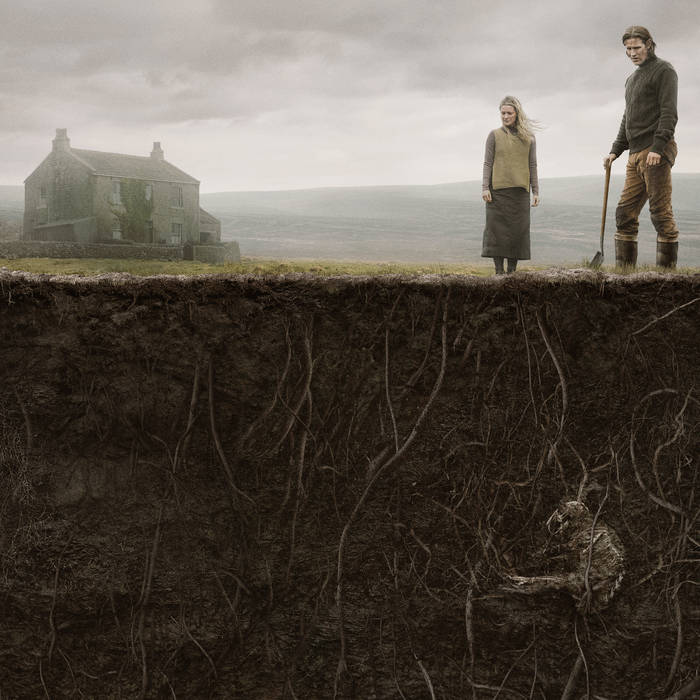
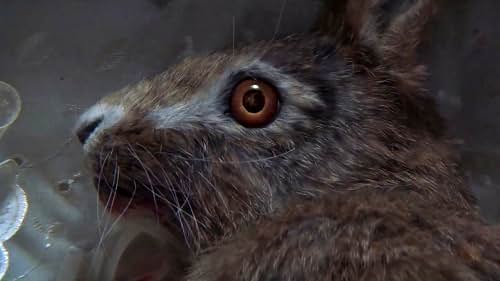
There is a dead hare on Richard Willoughby’s desk. By rights that should be the end of it. Bone has reached the acceptable stage of death, dry enough to be handled, labelled and thought about without anybody needing to consider what the animal used to feel like when it was warm. Then the bones begin growing themselves back. Tissue gathers where tissue has no business gathering. Organs return. Fur follows. The thing does not rise from the dead with the theatrical efficiency of a corpse in a Hammer film; it rebuilds itself patiently, one revolting biological improvement at a time. Starve Acre understands immediately that resurrection becomes much less comforting once you are forced to watch the plumbing go back in.
A ghost would be easier. Ghosts, for all their unpleasantness, retain something reassuringly human about them. They remain preoccupied with our concerns. A murder, an old bedroom, a promise, a staircase, a child, somebody who should never have bought that particular house. Even an angry ghost acknowledges that human life matters enough to leave a mark. The field outside Starve Acre suggests something older and considerably less flattering. Richard and Juliette Willoughby may own the house, inherit the land and arrange their domestic life over it, but the soil has not been asked for an opinion. The place has been there for longer than the paperwork and appears perfectly capable of waiting until the paperwork becomes irrelevant.
That is where Daniel Kokotajlo’s film finds the old nerve of folk horror. It is not enough to put antlers on somebody, mention Beltane and point a camera at wheat. The real unease begins when the modern world turns out to be thinner than expected. Richard is an archaeologist, which makes him beautifully suited to discovering this. His profession assumes that the buried past can be excavated, ordered and explained. Soil is removed, an object appears, context is established, and something formerly hidden becomes part of knowledge. The dead are supposed to cooperate. Starve Acre contains a past with no intention of remaining past tense.
Richard has returned to the place where he grew up under the shadow of his abusive father Neil, a man obsessed with the field, an old oak known as the Whistling Tree and the figure of Jack Grey, or Dandelion Jack. Richard has spent adulthood doing the sensible thing with all this: separating fact from the warped mythology of his childhood. Neil was cruel. His beliefs were ridiculous.
The old tree was cut down. The boy became an educated man, acquired a profession, a wife, a son and all the other furniture of adulthood which suggests that childhood has finally been placed somewhere behind us. Then Richard’s own son Owen begins talking about Jack Grey.
That is the first genuinely nasty movement in the film. Richard has not escaped the landscape of his childhood. He has brought another child back into it. The old pattern does not announce itself with drums or robes; it simply resumes. There is something familiar in that even without the supernatural. People return to old houses believing that their adult selves have changed the balance of power. A room is repainted, a wall is knocked through, the garden is cleared, and the building is expected to accept the new story. Houses are good at playing along because they live close enough to our timescale. Kitchens date quickly. Wallpaper becomes embarrassing. Extensions sag. A house can appear transformed within twenty years. A field is harder to impress.
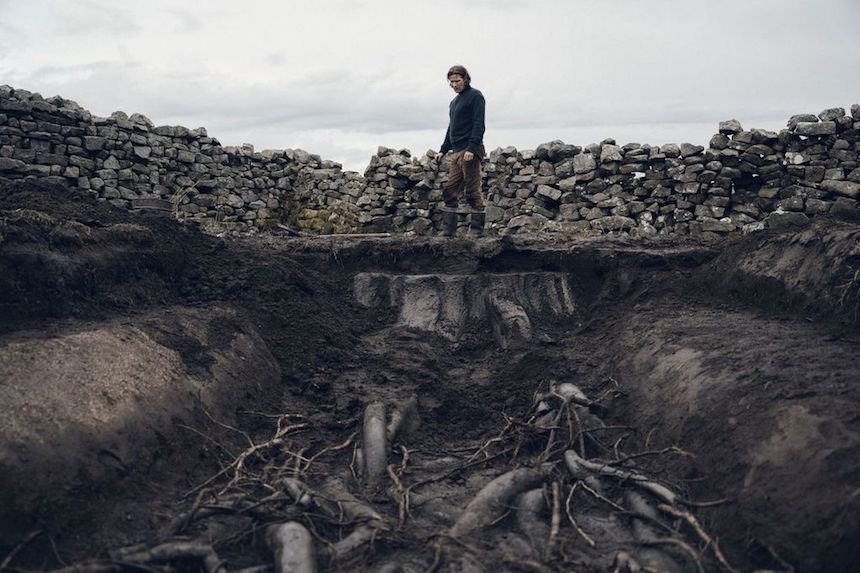
The Whistling Tree may have vanished from the surface, but beneath the soil its root system remains. Trees are particularly good at exposing the poverty of the human idea of disappearance. We tend to decide something is gone once we cannot see it. Cut down a trunk and the tree becomes a stump; remove the stump and the garden looks empty. Start digging and the tree comes back as a network, thick roots disappearing sideways into soil, gripping stones, crossing whatever neat boundaries have been drawn above. The visible tree was only the polite part.
Richard digs because digging is what he understands. There is something almost desperately rational about it. His son is dead, his wife is collapsing into grief, his father’s old stories have started leaking into the present, and the field at least gives him a practical problem. Somewhere under there is the tree. His father wrote about it. Owen spoke about Jack Grey. Soil can be removed by hand. A spade is wonderfully uncomplicated beside bereavement.
Owen’s death is what gives the film its weight. Children do not simply leave memories behind; they leave futures. The unused future is often the more terrible absence. There should have been another birthday, another Christmas, another bad haircut, another jumper grown out of, another argument over something trivial. The room still exists because the child’s life was supposed to continue through it. Grief has to live among objects which have accidentally outlived their purpose.
Juliette’s grief is made still worse by a thought she had during Owen’s fatal asthma attack, a fleeting sense that life might somehow be easier without him. It is the kind of thought grief can turn into a private torture device, because love does not prevent exhaustion and exhaustion does not cancel love. Starve Acre refuses to purify bereavement into something noble. Juliette is devastated, guilty, angry and receptive, which is far more dangerous than simple sadness. Jack Grey does not need to possess a happy family from scratch. The crack is already there.
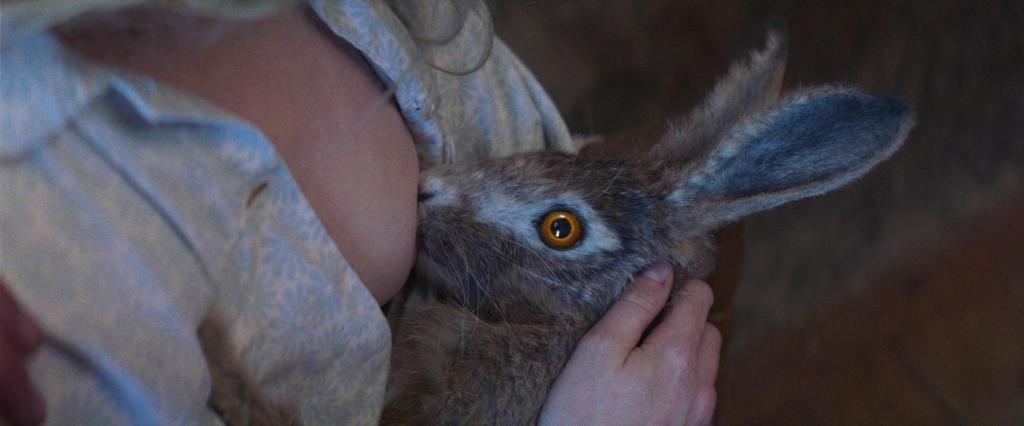
The resurrecting hare enters that crack with almost indecent precision. Juliette has lost the physical part of motherhood. Owen is no longer warm, hungry, noisy or present in the next room. Death has converted a person into memory. Then an animal appears which is emphatically alive. It eats. It breathes. It has weight. Its body can be held. The viewer knows that body began as old bones and watched the hideous manufacturing process take place, but Juliette sees something else: life where there had been absence.
The hare is a perfect animal for this because hares already seem slightly wrong before anybody introduces witchcraft. They sit too still, move too quickly and appear to possess some private awareness of the field around them. British and European folklore has spent centuries attaching them to fertility, witchcraft, moonlight, spring and transformation, but a hare hardly needs the help. See one sitting alone at dusk and it already looks like it remembers the previous owner of the land.
Kokotajlo makes the animal worse by refusing to let us forget its interior. Fur would normally soften an animal for us; here it covers evidence. We know there was a stage when the creature was simply bone, then another when it was raw tissue. By the time Juliette begins treating it like a child, the domestic image has already been poisoned. Her final act of nursing the hare lands somewhere between motherhood, ritual and body horror, and it works because the film does not treat old belief with the antiseptic reverence folk horror sometimes acquires. Old rural life was not a tasteful arrangement of antlers, candles and nice typography. It involved blood, milk, birth, slaughter, manure, infected wounds, dead livestock, damp soil and things being born in sheds. The countryside has never been clean.
There is something almost funny about how offensive the hare’s resurrection is to human expectations. We are surrounded by biological construction all the time. Every animal begins as cells multiplying in darkness. Bones form. Muscles attach. Organs arrange themselves. A heart starts beating. We accept the process because it normally happens in the correct order and behind a wall of flesh we do not have to inspect. Starve Acre simply lets the same process happen after death and in full view. Suddenly nature looks occult.
Spring gets away with much the same trick every year. For months the country appears exhausted. Trees stand bare, hedges thin out, fields become brown and wet, and then the whole thing quietly begins rebuilding itself. Buds appear. Insects return. Birds become noisy. Green spreads over things which looked dead a fortnight earlier. We call this pleasant because the calendar has reassured us in advance. If spring occurred once every three hundred years, it would probably be considered a national emergency.
Jack Grey belongs to that seasonal logic. Dandelion Jack is an especially good name because the dandelion is one of those plants human beings have declared war on largely for refusing to understand property. It grows through cracks, returns after cutting, blows seeds into carefully managed lawns and remains unmoved by our standards of horticultural decency. We call it a weed, which mostly means a plant has appeared without filling out the necessary forms.
Starve Acre itself is named through the same human annoyance. An acre which starves is defective land, ground judged according to what it produces for us. The title sounds like agricultural disappointment long before it sounds supernatural. Yet the field does produce something. It simply does not produce what the humans want. Perhaps Starve Acre is not barren. Perhaps Jack Grey is the crop.
That possibility makes the film much nastier than a simple story about nature taking revenge. Revenge would still leave humanity at the centre. The land would be angry with us, which at least means it has noticed us. Starve Acre keeps suggesting something less flattering. The cycle continues whether the Willoughbys approve or not. Bodies die, matter changes form, spring arrives, roots remain underground. From the family’s point of view Owen’s death is an apocalypse. From the field’s point of view something has gone into the soil and something else is coming out.
The old rituals surrounding Jack Grey make more sense once viewed this way. Folk customs are often handed down long after their explanations disappear. Do not go into a particular field. Do not answer a voice. Do not cut a certain tree. Leave something at a boundary. To a modern mind these rules sound ridiculous because the reasoning has gone missing. Starve Acre imagines the unpleasant possibility that the rule survived because the thing it was protecting against survived too. A superstition is easy to dismiss until it works. After that it becomes health and safety.
The buried Whistling Tree is especially good in this regard. Whoever put it underground did not preserve it as heritage. They suppressed it. There was no plaque, no visitor centre, no tasteful panel explaining the Legend of Dandelion Jack beside a QR code and a badly maintained picnic bench. The thing was cut down and covered with earth. Then an archaeologist arrives and begins carefully undoing the solution. Richard believes he is recovering knowledge. From Jack Grey’s side of the arrangement he may simply be performing maintenance.
This is one of the reasons the film has stayed with me while cycling through Shropshire and the Welsh borders. Not because every sunken lane makes me expect an ancient hare god to appear from behind a hedge, although that would certainly improve some commutes. It is because cycling exposes how provisional our occupation of landscape actually is.
A road looks permanent from inside a car. On a bicycle it starts revealing the compromises. It bends around a boundary established long before the tarmac. It squeezes between buildings constructed when nobody expected two SUVs to meet there. It follows the valley because water established the easiest route before the highway authority acquired stationery. A modern route planner turns this into a clean coloured line, but the legs encounter the older argument. The road rises because the ground rises. The gradient may now be 7.4 percent on a Garmin screen, but the hill was doing exactly the same thing before Garmin, bicycles, asphalt or the English language existed.
That does something useful to your sense of importance.
Wind becomes more than weather when there is no engine to cancel it. Rain changes the same road into another road. A climb enters the body. Knowledge does not help nearly as much as we like to imagine. I can know the gradient, length, elevation and wind direction of a hill and still have to ride up it. Data has described gravity without negotiating a discount.
Richard runs into the same problem with the field. He has the right tools, the right education and the right vocabulary. He can locate roots and examine remains. None of this grants authority over the thing he has found. Understanding and control are very different privileges.
After enough miles in rural country, human structures begin to look less permanent as well. A pub becomes a house. A chapel becomes somebody’s kitchen. A railway becomes a cycle path. A farm track points towards a building which is no longer there. Roads make unexplained turns around vanished obstacles. A line on a map can be the surviving shape of somebody else’s world.
Cycling is about the right speed for noticing this. Walking can make every yard intimate, while driving deletes too much. On a bicycle the layers pass quickly enough to change but slowly enough to remain visible. An old cottage, a quarry, a church, some 1980s houses, a ruined barn, a new estate, all threaded together by a lane that may be older than most of them. Then the road kicks upwards and any grand thought about history is suspended because your lungs have started issuing more immediate correspondence.
That physical vulnerability matters. At dusk, a familiar road can become unsettling without changing in any objective way. The light goes, the hedges thicken into dark walls, an animal’s eyes appear before the animal, and the beam from the front light creates a temporary little world beyond which almost nothing is visible. The road still exists beyond the light, obviously, but the body has begun receiving different information.
Nothing supernatural needs to happen.
The place only has to stop feeling arranged for you.
That is the atmosphere Starve Acre understands so well. The field does not leap out at Richard. It remains where it has always been. The house sits beside it, Juliette moves through rooms, people make tea, sleep, argue and grieve, while outside the ground continues holding something older than the family occupying it. Landscape horror works best when the landscape does very little. Movement would almost make it easier. The real discomfort comes from the possibility that the frightening thing arrived centuries ago and has simply been waiting without impatience.
Inheritance then starts to look different. Richard inherits Starve Acre in the legal sense, but the film gradually reverses the relationship. He returns to the place where his father’s belief system formed him, brings his own child into range of it and eventually becomes absorbed into the pattern he spent adulthood rejecting. Perhaps Richard does not inherit Starve Acre at all. Perhaps Starve Acre inherits Richard.
Property language cannot cope with this scale. We say “my house” and “my field” because grammar likes owners. A family may hold land for three centuries and begin speaking about it with the confidence of geology, but three centuries is nothing to the ground beneath the farmhouse. The oldest family on the oldest estate is still renting from time.
This is not mystical. Leave any human object outside for long enough and the process becomes obvious. Steel rusts. Rubber cracks. Timber rots. Moss gets into joints. Plants find openings. The machine, house or fence slowly stops being an object and returns to material. Nature does not need anger. It has patience.
Jack Grey gives patience a face, or at least a pair of ears.
That is the deeper unease behind the ending. The family is not simply destroyed. It adapts. Juliette has something to nurture. Richard has crossed into the belief system he once resisted. Jack Grey has returned and domestic life has somehow reorganised itself around him. Another horror film might burn the house down and send somebody sprinting towards the road. Starve Acre imagines something worse: accommodation.
People can get used to almost anything.
That may be how old gods survive. Not through continuous spectacle, but because eventually somebody learns where to put the bowl.
Given enough years, the events at Starve Acre might become folklore again. Details would blur, names would change, the house would pass to somebody else, the field would be sold, redecorated, fenced differently. Grass would make everything look harmless. The story would fade long before the land did.
This is the part that follows me out onto the road. A ride feels personal while it is happening because I chose the route, measure the miles and experience every gradient directly. Yet the physical evidence of my passage is almost nothing. Two wet tyre lines disappear. Mud dries. The road begins again for the next person with no memory of what it did to my legs yesterday.
There is comfort in that until the same thought is applied to everything else.
The house is temporary too. So is the field boundary. So is the road. The oak lasts longer, its roots longer still, and the ground beneath all of them carries on while ownership, family names, technologies and beliefs change above it.
Starve Acre makes this ordinary truth feel malignant without ever needing to prove that the land itself is evil. That would almost be too easy. Evil would make us significant enough to hate.
The film suggests something colder. The land knows how to wait. It knows how to bury. It knows how to grow things back.
We are the ones who keep mistaking our brief possession of the surface for mastery.
Perhaps that is why Richard’s spade feels more frightening than any ritual blade. He is not entering an unknown world.
He is simply removing the thin layer that allowed him to believe the old one had gone.


Leave a Reply